Friday, March 26, 2021

 REGIONAL #95:  This group had no pennant winners but lots of variety:  a standard deviation of 42 years around a mean season of 1964!   In thinking about contenders, I knew the Mets would win a pennant the following year, I suspected (as I incorrectly had in the last regional) that the Tigers were pretty good, and Giants teams from the 1970's had already captured three regionals and tend to play over their heads.  I picked the Mets over a steroid-era Padres team in the finals.  The ELO rankings instead picked the 1911 Cubs to beat the Mets, which I figured must involve some remnants of the Tinker to Evers to Chance group; however, I was comfortable with my choice as I doubted that a deadball era team would stand much of a chance against a similarly-ranked steroid-era squad.

 First round action  

My main recollection of the 96-loss 1971 Senators was that they had Frank Howard, one of my favorites from that era, but aside from a pretty good bullpen they had little else. I was thinking that the 1911 Cubs (92-62, 2nd place in the NL) had never seen the likes of Howard's 26 HR before, but Cubs RF Wildfire Schulte hit 21 HR himself--and he also hit 21 triples, almost as many as Hondo hit in his entire career! The Senators meager offense isn't helped when DH Jeff Burroughs is lost to injury for the tournament in the 3rd inning. The Cubs take a 1-0 lead in the 4th when Schulte doubles and Heinie Zimmerman singles him in, but the Nats tie it immediately in the top of the 5th when Howard doubles in Don Mincher on a missed HR split. In the 6th, Washington reels off four hits against Three Finger Brown, including a Tim Cullen triple, and suddenly the Senators hold a 4-1 lead and Cubs manager Frank Chance inserts himself into the lineup to try to provide a spark. In the 7th, Brown loads the bases on a hit and two walks, and the Cubs have to pull their HOFer in favor of Charlie Smith, who holds the Senators to 1 run on a Toby Harrah sac fly, but it's now 5-1 and Nats starter Pete Broberg is looking more like Pete Alexander. Two straight hits against Smith in the 8th, followed by a Hondo 3-run HR, and it's 8-1 Washington and Cubs fans are starting to blame a goat that won't even be born until 30 years later. And so it ends, with Broberg tossing a 3-hitter and Washington raking Cubs pitching for 17 hits, and the ELO regional favorite is blown out of the tournament in the 1st round.

The 76-win 1997 Padres against the 82-71 1927 Tigers posed an interesting matchup between a mediocre steroid era team and a decent team from the classic era.  After setting the lineup the Tigers looked like a much better team than the 1941 squad that won the previous regional, led by Harry Heilmann's gaudy .398 batting average, although the Padres' Tony Gwynn and his .372 average wasn't far behind.  The Tigers show Padre starter Joey Hamilton their hitting prowess early, batting around in the 2nd inning to score 5 runs with Neun and Gehringer both contributing 2-RBI singles.  The Padres respond with a run in the 3rd when Caminiti singles home Gwynn, but when the Tigers open the bottom of the 3rd with three straight hits, San Diego feels it has to go to closer Trevor Hoffman if they are going to have a chance in this game, so Hamilton departs after allowing 9 hits in 2 innings.  Hoffman promptly allows a hit, and the Tigers now lead 8-1 after three.  The Tigers score again in the 4th on a Taverner fielders choice, and meanwhile Tigers starter Earl Whitehill is cruising.  Fothergill drives in another Tiger run in the 8th against the third Padre pitcher, Bruske, and that puts the cap on the 10-1 Tiger victory and a convincing win for the classic era, although for a steroid-era squad the Padres were not a particularly power-laden example.

My choice for regional favorite, the 1999 Mets won 97 games and made the NLCS with lots of weapons--power, average, speed, defense, and a lockdown closer in Armando Benitez.  They faced a good 89-win 1978 Giants team who had a strong Bob Knepper on the mound, but on cardstock the Mets still looked like the better team by a comfortable margin.   However, the 1st inning had a lot of uncomfortable omens for the Mets--first, leadoff batter Terry Whitfield belts a HR, followed by an error from Mets 2B-1 Edgardo Alfonso; then when the Mets get their shot in the bottom of the 1st, leadoff hitter Roger Cedeno gets a single but is nailed by Marc Hill stealing 2nd despite Cedeno's AA rating.  Leading 1-0, the Giants then load the bases in the 4th with nobody out, but Al Leiter pitches his way out of the jam and keeps any runs from scoring.  The Mets finally get a run to tie the game in the bottom of the 7th when Piazza leads off the inning with a towering blast into the deepest reaches of Shea Stadium, but in the top of the 8th Darrell Evans leads off with a walk followed by a Jack Clark 2-run shot, and the Mets have to go to Benitez to try to keep things from getting worse.  He does his job, but the Mets offense is helpless against Knepper; they finally get a hit and a walk in the bottom of the 9th, putting John Olerud up as the potential game-winning run with one out, but Olerud hits into a double play, and the Mets go down quietly 3-1, while the Giants move on to the semis.

The 2017 Phillies lost 96 games and were a bad modern era team, but they still had 8 players in their lineup with a SLG% above .400, whereas the deadball 1911 Cardinals managed to go 75-74 with only two such sluggers.  The Phillies also had one decent starting pitcher, Aaron Nola, and the lone sub-.400 SLG% hitter in the Philadephia lineup--SS Freddie Galvis--staked Nola to a 1-0 lead on an RBI single in the 3rd.  The Cards tie it in the 4th, and then move to a 3-1 lead in the 5th courtesy of an Ed Konechty double.  St. Louis starter Slim Sallee is in control until the 7th, when Cameron Rupp hit a 2-out solo shot to narrow the lead to 3-2 Cards, but Mowrey's RBI single in the bottom of the 7th makes it 4-2 and then Miller Huggins finds Nola's HR result in the 8th to push the lead to the final margin of 6-2 Cardinals--the first of three 1911 teams in the past two regionals to survive the first round.

The survivors

Both the 1971 Senators and the 1927 Tigers won blowout games in the 1st round, with the Senators win being the bigger surprise.  Both teams had a significant dropoff in their #2 starters, with neither Dick Bosman nor Sam Gibson able to put together a winning record.  A two-out rally in the 2nd, culminating in a triple by DH Lu Blue, puts the Tigers up 2-0, and in the 3rd the Senators lose SS Toby Harrah to a 15-game injury--having already lost DH Jeff Burroughs for 10 games in the 1st round.  The Tigers put up two more in the 4th, and in the bottom of the 8th when Larry Woodall finds Bosman's HR result for a 3-run blast, the Senators summon Joe Grzenda and his 1.93 ERA, but that doesn't help and when the inning ends after 6 Tiger hits and 3 Senator errors, the score is 10-0 Detroit.   And that's how it ends, with Sam Gibson channeling Bob Gibson to record a 6-hit shutout, and the Tigers are on a roll seeking to capture a second straight regional for the franchise.

Bob Beats Blue
The 1978 Giants and the 1911 Cardinals both had their workhorses on the mound for their semifinal matchup, with Vida Blue (18-10, 258 IP) against Bob Harmon (23-16, 348 IP).  In the 2nd, the Cards lose LF Rube Ellis to a minor injury, and the lack of bench depth in these deadball era squads becomes glaringly apparent.  Even so, both workhorses are in fine form, and entering the 9th inning the game remains in a scoreless tie.  In the top of the 9th, Giants 1B Mike Ivie misses a HR split, and is stranded at second as Harmon records three straight outs.  For the Cards in the bottom of the 9th, Steve Evans leads off with a single, Blue whiffs Bresnahan, and Konechty hits a grounder to SS-3 Metzger, who can't complete the DP and Evans goes to 2nd as the potential winning run.  Blue delivers to Mike Mowrey--it's a 6-2 roll, and what should be there but a weird DO 1/SI** split; Evans scores and the Cards squeak into the finals with a 1-0 victory on Harmon's 5-hit shutout.


Not since Regional #43 had two pre-WWII teams faced off in a regional final, with both the 1927 Tigers and 1911 Cardinals disposing of more modern opponents in the first two rounds.  The Tigers had blasted their opposition to reach the finals, and they start off fast against the Cards, with Neun drawing a walk to lead off the top of the 1st, stealing second, and then Gehringer singles him home.  Three more straight hits and it's 3-0 Tigers before St. Louis has picked up a bat.  However, the Cards attempt to show that they aren't going down as quietly as had earlier Tiger opponents, with Miller Huggins leading off the bottom of the 1st with a HR off Tiger starter Ken Holloway's card.  Cards starter Bill Steele settles down, but in the 7th the Tigers load the bases with nobody out and convert for 2 runs on a Larry Woodall single, and they add 2 more in the 8th on RBIs from Heilmann and Fothergill to make it a 7-1 game.  Meanwhile, the Cards efforts are repeatedly stymied by the Tigers all-"1" DP combo, and Holloway ends with a 6-hit 7-1 victory and the Tigers win a second straight regional, outscoring the opposition by a 27-2 margin.


Interesting card of Regional #95:  Charlie Gehringer has always been one of my favorite players from the pre-WWII era, having served as a consistently productive member of various teams I've had in draft leagues I've played over the years.  I thought it was appropriate to select his card to be featured because the last two regional winners, the 1941 Tigers and the 1927 Tigers, had exactly one player in common:  Gehringer.  His 1941 card showed him as a shadow of his former self (although he still drew 95 walks), but the 1927 card pictured here reflects a 24 year just starting to show the abilities that would be on display for the next 15 years.  Although elected to the Hall of Fame, I've often thought that Gehringer has been somewhat overlooked among the greats of the game; for example, in 1929 he led the league in games played, plate appearances, runs scored, hits, doubles, triples, and stolen bases; he drove in 106 runs and had an OPS of .936--all that, and he didn't receive a SINGLE vote for MVP.  The baseball writers did finally award him the MVP in 1937, when he led the AL in batting with a .371 average.


Thursday, March 18, 2021

REGIONAL #94:   The draw for this regional was seriously old school, with only one team that played after the Kennedy administration.  Although I initially didn't notice any pennant winners, I had forgotten that the '48 Braves won the NL in their last gasp in Boston.  I did know that the '38 Giants were at the tail end of a very successful dynasty, those '86 Cubs were pretty good as I remembered, the '60 Braves probably retained many of their weapons from their late 50s pennant winners, and the '41 Tigers had won the AL the previous year and would do so again after the war.  Overlooking those '48 Braves, I felt that the Cubs-Tigers 1st round matchup would critical, and I picked the '41 Tigers over the '60 Braves in the finals.  The ELO rankings did not overlook the Braves' pennant, although they did rank three AL teams as better than the Braves that year; those rankings also pegged the two Braves teams in this regional as the two best, with the 1948 version favored over the Giants in the finals.

 First round action:  

The 1938 Giants went 83-67, good for 3rd place in the NL, and their two Hall of Famers, Carl Hubbell and Mel Ott, were key components of the team.  They expected an easy time against the '55 Orioles, who lost 97 games, had no power (54 team HR), and were ranked as the worst team in the regional.  Sure enough, the Giants greeted Baltimore starter Jim Wilson with 4 hits and 4 runs in the bottom of the 1st inning, and in the 6th the 3rd Oriole error of the game opened the floodgates for another 4, with a Hank Leiber double providing the big blow.  The O's finally push across a run in the 7th against Hubbell on a Willie Miranda RBI single, but the Giants add two more in the 8th on another Leiber double and a Dick Bartell solo shot.  The 35-year old Hubbell finishes things out with a businesslike 6-hitter, and the Giants move on with the lopsided 10-1 victory.

My selection of the '41 Tigers to win this bracket was made, as is my tradition, without looking at any of the teams involved, and I discovered that although the names I expected were there, the performances weren't:  Hank Greenberg only had 67 AB, Charlie Gehringer was an old "4" fielder, Bobo Newsom managed to lose 20 games, and the team as a whole had a mediocre 75-79 record.  However, the '86 Cubs weren't anywhere near as good as I thought I remembered, as although they had some pop in their lineup in the form of Ryne Sandberg, Leon Durham, Ron Cey, and Gary Matthews, they still managed to lose 90 games.  The Cubs load the bases in the bottom of the 2nd against Tiger starter Al Benton, but can only convert one run on a Dunston sac fly; in the 3rd, the Cubs lose Jody Davis to injury.  The Tigers don't get a baserunner until the 5th, but that walk seems to shake Cubs starter Scott Sanderson; another hit and a Frank Croucher double ties the game, although slow Birdie Tebbetts is nailed at the plate to end the inning.  Durham's 2-run HR in the bottom of the inning puts the Cubs back on top, but in the 6th the Tigers continue their beating of Sanderson, with squib singles and a sac fly giving the Tigers a 4-3 lead.  When Sanderson allows a hit to begin the 7th, the Cubs have seen enough and summon Lee Smith, who does his job but it is too late as Benton has the Cubs under control.  The Tigers escape with a come-from-behind 4-3 win, although they lose OF Pat Mullin to injury for the second round--meaning that Hank Greenberg will be making an appearance.

The pennant-winning '48 Braves went 91-62 and were in the midst of their "Spahn and Sain and two days of rain" era, although in fact there was talent in the rotation from other pennant-winners including Vern Bickford and Nels Potter.  The 73-win 1951 Tigers had few holdovers after a decade from the team that won the previous game, with Vic Wertz being their primary offensive weapon.  The Braves put up a run against Dizzy Trout in the bottom of the 2nd on a Phil Masi RBI single, but the Tigers clawed back hard in the 3rd, opening the inning with 3 straight hits against Sain and then Pat Mullin avenged the injury to his 1941 self in the prior game with a 3-run homer, and the Tigers led 5-1 after 3.  Detroit puts another 5-spot on Sain in the 8th, with Johnny Groth contributing a 3-run blast, and the Braves can't sustain anything against Trout, who ends with a 7-hit CG and the Tigers move on with a convincing 10-1 win over the ELO regional favorite.

After bypassing 1948 Warren Spahn in the previous game and having Johnny Sain get shelled, I decided I wouldn't make the same mistake with the 1960 Braves, who finished 2nd in the NL with an 88-66 record; with the meat of the Braves lineup consisting of Aaron, Mathews, and Adcock, it looked like the deadball era 1911 White Sox (who went 77-74) had their work cut out for them, although they had their own Hall of Famer on the mound in big Ed Walsh.  However, the Braves explode against Walsh in the 2nd, with two bad plays by Sox 2B Amby McConnell opening the door for six Milwaukee runs, with two on an Aaron HR and another two on a long single by Johnny Logan.  McConnell atones slightly with an RBI single in the bottom of the 2nd, and the Sox collection of slap hitters really comes alive against Spahn in the 5th for four more runs, with Harry Lord knocking in two with a double.  With the game now at a tight 6-5 score, both HOFers bear down and neither squad can score for the remainder of the game, which allows the Braves to escape with the 6-5 win and the chance to avenge their 1948 comrades in the semifinals.

The survivors:

After needing a come from behind win in round one, the 1941 Tigers decided to try playing from ahead in their semifinal against the 1938 Giants, loading the bases against Harry Gumpert in the 2nd inning with nobody out, but they could only convert one run on a Croucher sac fly.  The Giants break through against Tommy Bridges in the 5th, with a Dick Bartell double scoring one, followed by a walk to load the bases for HOFer Mel Ott--who hits into a fielders choice that nonetheless scores the go-ahead run.  The Tigers retake the lead in the 6th, when a Greenberg walk is followed by a Bruce Campbell HR that makes it 3-2.  The Giants respond in the 7th on another bases loaded fielders choice that ties the game, but in the process they lose SS Dick Bartell to injury for the rest of the tournament.  Once again, the Tigers respond in the bottom of the 8th, with a sharp single by Croucher scoring Campbell from second giving the Tigers a 4-3 lead.  That means it's up to Bridges and the terrible Tiger defense to hang on in the 9th, and after 2 quick outs injury replacement George Myatt singles to bring up Mel Ott as the potential go-ahead run.  But Ott squibs it back to Bridges, who fields it cleanly, and the Tigers win 4-3 and head to the regional final.

The semifinal between the 1951 Tigers and the 1960 Braves featured two teams on a mission, which for the Tigers involved seeking an all-Tigers final, while the Braves sought to avenge the first-round loss of their 1948 counterparts to these same Tigers.  As they did in round one, the Braves got off to a quick start, knocking around Virgil Trucks for four hits and two runs in the 1st inning, and adding another three runs in the 2nd on back to back doubles by Mel Roach and Hank Aaron.  When Trucks allows 3 straight hits to start the 3rd, the Tigers run up the white flag on Trucks and try Hal Newhouser, but he isn't much of a relief and when the dust clears the Braves now have a 10-0 lead after 3 innings--and the Tigers still haven't had a baserunner against Milwaukee's Bob Buhl.  Detroit does get on the board in the 4th on a walk and a Pat Mullin double, but the Braves add a run in the 6th on a Bruton sac fly.  In the 8th, the Tigers wake up and begin playing like the team that won big in round one, scoring four (three on a Mullin HR) to cut the deficit to 6 runs.  But Buhl sets down the Tigers in order in the 9th, and the Braves win 11-5 to move to the finals to face a different version of the Tigers.

2-0 in the Regional


I had picked the 1941 Tigers to win this regional because I remembered that the Tiger teams of the 30s as being quite good.  However, after assembling their lineup I discovered that they were seriously flawed, with an all "4" double play combo backing up a starting rotation that couldn't seem to throw strikes.  Nonetheless, here they were in the regional final, seemingly overmatched against the powerful 1960 Braves and 19 game winner Lew Burdette.  The Tigers tapped Dizzy Trout for the start, maybe because a 10-year-older version of Trout had defeated a different Braves team in the first round of this regional, but this Trout walked almost three times as many batters as Burdette in roughly half the inning pitched.  And that sets the stage for the 1st inning, where Trout walks the bases full but escapes with no damage; then Trout walks two more in the 2nd, but again the Braves can't capitalize.  In the 3rd, Bruce Campbell rolls and misses Burdette's HR split, but the resulting double scores two and the Tigers lead 2-0.  A Campbell triple in the 7th scores another two, and the Braves still don't have a hit (but plenty of walks) against Trout.   Finally, in the bottom of the 7th Mel Roach breaks up the no-hitter with a 2-out single, but it doesn't lead to anything.  With little help in the Braves bullpen, the Tigers pound Burdette for 4 hits and 3 runs in the 9th, with Pat Mullin apparently recovering well from his 1st round injury as he contributes a two-run double.  In the 9th, Trout again walks the bases loaded, but strikes out Adcock to seal the shutout, the 7-0 win, and the regional for the Tigers.  Trout pitches a 2-hitter, but walked an amazing 13 batters yet still threw a shutout!  Note that although it was based entirely on ignorance, this was my 2nd correct prediction of a regional winner in a row after a long dry spell.


Interesting card of Regional #94: Because of his limited AB, HOFer Hank Greenberg could only start in this regional as an injury replacement, and he did so admirably with a hit and two walks in the second round for a .750 OBP.  However, the most interesting aspect here involves the reason for his limited AB:  he was drafted for military duty and had to report for duty on May 7, 1941, hitting his only two HR of the season against the Yankees in his last game before leaving.  However, around the end of the 1941 season, Congress voted that men over 28 years old were exempt from the draft, and the 30 year-old Sgt. Greenberg was given his discharge--on December 5, 1941.  However, the Japanese attacked Pearl Harbor two days later, and Greenberg immediately enlisted in the Army Air Corps, serving in southeast Asia in the Burma campaign.


Wednesday, March 10, 2021

REGIONAL #93:  This was a bracket that included a nice mix of old-school and more recent squads, with only one team from this millennium.  Trying to pick a winner from memory, I was somewhat stumped; I knew the Indians had won a pennant a few years earlier and the Blue Jays would win a pennant a few years later; I remembered 1983 being Johnny Bench's last season (celebrated at the All-Star game in Old Comiskey), and I couldn't remember if the Pirates had begun their decades-long funk by 1997.  I figured the steroid-era Indians had to have a puncher's chance so I picked them; for a change the ELO ranks aligned with mine, picking the Indians over the Jays in the final.  


First round action:

Both the 74-79 1941 Giants and the 77-85 1962 Orioles struck me as pretty decent teams that should have been capable of .500 records; the Giants had two Hall of Famers in the lineup and one--Carl Hubbell--on the mound, while the Orioles responded with their own HOFer--Robin Roberts--on the mound, another (Brooksie) in the lineup, and a third in the bullpen (Wilhelm), which doesn't even count the two HOF managers they had as bench players--Whitey Herzog and Dick Williams!  It looked like it was going to be a long day for Hubbell, as the first two rolls for the Orioles were on Hubbell's HR reading, although both missed the 1-10 split.  Nonetheless, the Orioles jumped to a 2-0 lead in the 1st, but a Mel Ott single narrowed it to 2-1 in the 3rd.  The Orioles make it 3-1 in the 6th on a Boog Powell single, although a second run is cut down at the plate to end the inning.  The Giants get 2 on with 2 out in the 8th and the O's decide to pull Roberts and go to Wilhelm to seal the deal, and he strikes out Dick Bartell to end the threat.  Brooks Robinson then leads off the 9th by rolling yet another Hubbell HR result, and this time he gets the split to push the lead to 4-1.  And they needed it--in the top of the 9th the Giants stage a furious comeback against Wilhelm, recording 4 hits with RBI singles from Ott and Johnny Rucker, and cleanup hitter Babe Young comes to the plate with the tying run on 3rd and the go-ahead run in the form of Ott on 1st.  But Wilhelm fools Young with a knuckler, and the resulting popout provides the narrow escape for the 4-3 Orioles win.

The 1988 Blue Jays won 87 games and had a number of weapons going for them, including staff ace Dave Stieb on the mound, but the 61-49 1981 Astros won the "second half" of that strike season and had a great equalizer--Nolan Ryan and his 1.69 ERA, making an appearance in his 3rd straight regional.  The game stays scoreless until the 5th, when Phil Garner misses Stieb's HR split but the resulting double sends fleet Terry Puhl home for a 1-0 lead.  Alan Ashby makes it 2-0 on a fielders' choice in the 8th, and it looks like the Blue Jays just cannot solve Ryan. However, in the bottom of the 9th a single and a walk put Jays on 1st and 2nd, and with one out George Bell hits a grounder to Houston 3B-2 Art Howe, who can end the game with a DP but throws it into the dugout for a 2-base error.  The score is now 2-1, with the tying run on 3rd and the winning run at 2nd; the Houston infield comes in and Ryan is looking for the strikeout. However, Kelly Gruber slashes a liner over the head of CF Tony Scott, both runs score, and the Blue Jays manage the come-from-behind walk off 3-2 win against perhaps the best pitcher in the regional.

When my random team selector program came up with the 1997 Pirates, I couldn't remember if they had yet begun their long residency in bad-team purgatory that persisted for at least 20 years, and the answer was "sort of":  the team was under .500 at 79-83 but still managed to finish 2nd in the NL Central.  However, they looked like the 1927 Yanks compared to the 1954 A's, a 51-103 team that couldn't hit, pitch, or field and was so bad they were evicted from Philadephia following the season.  The Pirates edged out to a 1-0 lead in the 2nd on a Jason Kendall sac fly, and make it 2-0 in the 4th on a Dunston fielders choice.  However, the A's tie it up in the 5th when Pirates CF Jermain Allensworth can't get to a Jim Finegan fly that falls for a double, scoring two.  That lead doesn't last long, as A's starter Arnie Portocarrero loads the bases, and Pirates PH Turner Ward and his 1.007 OPS comes through with a single that makes it 4-2 Pittsburgh.   In the top of the 7th, a Lou Limmer solo HR narrows it to 4-3, and when Vic Power doubles with 1 out in the 8th the Pirates summon Ricardo Rincon to relieve Francisco Cordova, and Rincon records two quick strikeouts to end the threat.  Rincon continues his streak in the 9th, striking out the side to earn the save in the 4-3 Pirates win, and record the admirable pitching line of 5 BF, 5 K's.

The 2000 Indians won 90 games to finish 2nd in the AL Central, and featured steroid-fueled power throughout the lineup along with an all "1" infield, although they elected to start snakebit Chuck Finley, who had lost 4 of his 5 previous starts in this tournament.  Even so, they felt confident that they could handle the 74-win 1983 Reds, with limited offense but with Mario Soto throwing bullets on the mound.  The Indians took a 1-0 lead on a Manny Ramirez RBI single in the bottom of the 1st, but the Reds immediately tied it in the 2nd when Nick Esasky tripled in a lumbering Johnny Bench, who was on the verge of retiring.  Travis Fryman hits a 2-run HR in the 4th to make it 3-1, and the Indians add another run in the 5th on another Ramirez RBI single.  However, the Reds load the bases against Finley in the 8th with 1 out, and Cleveland closer Bob Wickman is summoned from the pen.  One run scores on a Bench sac fly, and it's 4-2 entering the 9th.  Wickman loses control in the 9th, with a single and 2 walks loading the bases with one out, and Wickman then issues another walk to make it 4-3.  After a conference on the mound, the Indians stick with Wickman with the bases still loaded, and he rewards that decision by striking out Gary Redus and Dan Driessen in succession, preserving the 4-3 win and the semifinal trip for the Tribe.  Worthy of note:  every first round game in this regional was won by a single run.


The survivors

The underdog 1962 Orioles greeted 1988 Toronto starter John Cerutti with four hits and three runs (two on a Jackie Brandt triple) to start the first semifinal game, putting the Blue Jays on notice that they faced another uphill climb if they were to survive this round.  To show that they were not intimidated, Jays leadoff hitter Tony Fernandez hits a solo HR off O's starter Milt Pappas' card, and it looks like it's game on.  But looks can be deceiving; from that point forward, both Cerutti and Pappas dominated the opposition and neither team could mount a threat.  When Pappas allows only his 3rd hit in the 8th inning, the O's turn the ball over to Dick Hall fearing Pappas' propensity for the longball, and Hall does the job, closing things out for a 3-1 Orioles win and a trip to the finals.

Slender but hittable

The 2000 Indians trotted out not-yet-portly Bartolo Colon to face Steve Cooke and the 1997 Pirates, and the Pirates treated Colon rudely in the 1st, with a leadoff hit followed by a double and then a long single by Joe Randa that made it 2-0 Bucs. A clutch hit by Sandy Alomar Jr. made it 2-1 in the bottom of the 2nd, and then a Kenny Lofton single tied it up in the 6th--all the more remarkable as Lofton had managed to hit into DPs in both of his previous at-bats. Meanwhile, Colon is struggling, allowing 10 hits in the first 6 innings but somehow repeatedly managing to escape damage. In the 7th, the Indians get runners on the corners and the Pirates turn to Rincon, the savior of the first round game--and Jim Thome takes Rincon's first offering over the wall for a 3-run shot and a 5-2 lead. However, Pittsburgh strikes back in the 8th, with Jose Guillen knocking in a run (at which point Colon exits in favor of Steve Karsay); Tony Womack then singles Guillen to 3rd and steals 2nd himself, and the tying run is now in scoring position with 1 out. However, Jermaine Allensworth rolls the dreaded LOMAX, and the Indians escape still holding the 5-3 lead. The Pirates have nothing against Karsay in the 9th, and Kenny Lofton makes a nice play in CF to secure the 5-3 Indians win and earn the Tribe a chance for a record 10th regional win for the Cleveland franchise.

Both the regional favorite 2000 Indians and #4 seed 1962 Baltimore had gained the final with narrow victories in the first two rounds, but I couldn't help get the feeling that we hadn't yet seen the Indians offense in full flower.  The pitching matchup between CLE Dave Burba and BAL Chuck Estrada also left room for plenty of scoring, although both teams had their bullpens pretty much at full strength for the game.  Nonetheless, nobody could get on the board until the 4th inning, when the Indians can only convert a bases-loaded opportunity into one run on a Travis Fryman sac fly.  History repeats itself in the 8th, when the Indians load the bases again, the Orioles summon Wilhelm from the pen, and Cleveland can only score one on a Thome sac fly.  With Burba throwing the 3-hit shutout, the Indians decide to leave him in to start the 9th, but when he walks PH Earl Robinson with one out the Tribe summons closer Bob Wickman, who fans Brandt but allows a single to Russ Snyder to bring up HOF Brooks Robinson as the go-ahead run at the plate.  The roll:  2-11, strikeout...just below that 2-10 solid HR.  The 2-0 victory gives Cleveland it's tournament-best 10th regional win and my first accurate prediction of a regional winner in a long time.  However, the unexpected MVP of the series:  the Indians defense, without a single error in the entire regional and that all-"1" infield making play after play to bail out otherwise shaky starting pitching.

Interesting card of Regional #93:  Although the Indians won the regional, it wasn't because of Manny being Manny; Ramirez didn't hit a HR in any of the games, although he had several timely singles that were more reminiscent of Manny Mota.  However, very unlike Mota, this Manny led the AL in SLG% and OPS in what proved to be his last year with the Indians.  Ramirez hit 555 HR over his career, which should have made him a lock for the HOF, but multiple positive PED test results and his consistent history of flakiness pretty much doomed his candidacy; this past year, his 5th year on the ballot, he was listed on only 28.2% BBWAA ballots.  Nonetheless, his 2000 card is something to behold.


Monday, March 1, 2021

REGIONAL #92:  This regional had no pennant winners, nor did it have any teams from the classic era, with teams mainly ranging from the disco era to the steroid era.  I didn't have sharp memories of any of these teams (turns out there were three good division winners here), although I seemed to recall some strong pitching from the mid-80s Astros and two other teams, the 1978 Royals and the 2000 Angels, who would each win the AL pennant two years later.  Given that an Angels team had won the prior regional and the 2000 version was smack at the peak of the steroid era, I figured I'd put my money on them.  The ELO rankings suggested that I (as usual) chose unwisely, tapping the Angels as the second-worst team in the regional; instead, those rankings pick the 2012 Nationals over the Royals in a very tight matchup.  I haven't correctly predicted a winner since Regional #82 anyhow, so being wrong here would maintain the status quo.

First round action

I had figured the 2000 Angels (82-80 W/L record) to be a prototypical steroid-era team, and I was right:  6 guys in the lineup with at least 25 homers, and not a decent starting pitcher in sight.  By the ELO ranks, they were slight underdogs against the similarly-.500ish 1981 Giants (56-55), who not surprisingly had better pitching but had Jack Clark leading the club with only 17 homers (albeit in a strike-shortened season).  The question of this Bay-area faceoff appeared to be whether the Giants' Vida Blue could keep the power of the Angels in check.  The Giants start off with a quick 1-0 lead on a Jeff Leonard solo HR in the bottom of the 1st; however, back-to-back shots by Mo Vaughn and Ron Gant to lead off the 5th put the Angels up 2-1.  A sac fly by Leonard in the 6th ties the game, and both Blue and Angels starter Ramon Ortiz keep the rest of regulation scoreless, and we head to extra innings tied 2-2.  Blue blanks the top of the Angels order in the top of the 10th.  In the bottom of the inning, Ortiz gets two quick outs, then singles by Joe Morgan and Larry Herndon put the winning run on 3rd and Jeff Leonard up again.  Ortiz delivers, the roll is 5-7, TR 1-2/flyB; split die for Leonard.....it's a 2!  The Giants get the walk-off win behind Vida Blue's 5-hit, 10-inning performance and Leonard's one-man show offense, and my pick for the regional goes down in round one.

As the second millennial team of the regional, the 73-win 2000 Brewers were an inferior version of the Angels team we just saw; 3 guys hitting 30+ homers and a pitching staff littered with stiffs.  The 92-win 1978 Royals won the AL West and were the polar opposite of the Brewers; excellent pitching and defense but an offense built around singles hitters and speed.  The speed of the Royals was apparent early, when in the 2nd inning Amos Otis doubled and Hal McRae singled him home for a 1-0 Royals lead.  Meanwhile, Larry Gura allows no Brewer hits until the 5th, when Henry Blanco singles in a run.  Blanco, as a C-1, is also holding the Royals speed in check, so KC tries a different tack:  the longball, and a 2-run shot by Darrell Porter and a 3-run blast by Frank White contribute to a 7-1 lead, and that is the final score as Gura completes the 3-hit victory.

Putting together the lineup for the 2012 Nationals made me understand why they won 98 games and the NL East, and why the ELO ranks would favor this team; good pitching both starting and relief, solid defense, and four guys hitting over 20 HR in the lineup.  The 83-win 1988 Padres were an okay team--decent pitching, but no hitters with 20 HR and some guys who could neither field nor hit in the starting lineup (Keith Moreland, we're looking at you).  Roberto Alomar put the Padres up in the 2nd when John Kruk raced (?) home from second on a long single.  The Nats immediately responded with four straight hits against Eric Show in the top of the 3rd, including a 2-run Bryce Harper double, that made it 3-1 Washington.  The Nationals add four more in the 4th, including a bases loaded double by Harper that scores 3, and with the last out of the 4th Show is mercifully injured and he must turn the ball over to Padres relief ace Mark Davis.  Davis does his job, holding Washington scoreless for 4 innings while the Padres chip away at Gio Gonzalez and narrow the lead to 7-3.  However, Davis is burnt after 4 and new reliever Lance McCullers is greeted with a 5-hit barrage in the top of the 9th that includes a 2-run Harper homer (making 7 RBI for him), and afterwards the shell-shocked Padres go down in order to give the Nationals the dominating 11-3 victory.

As I had vaguely remembered, the 96-win 1986 Astros did indeed have a very strong pitching staff, including Nolan Ryan and Mike Scott at his scuffball best, which enabled them to win the NL West.  Turns out that their opponent was pretty good also--the 2019 Brewers won 89 games and finished 2nd, making the postseason as a wild card team largely because of a power-packed lineup led by Christian Yelich's 1.100 OPS.  However, Scott keeps the Brewer lineup in check, allowing only a Moustakas RBI single in 10 innings, but the Milwaukee staff keeps pace, with starter Zach Davies eventually giving way to Josh Hader and Junior Guerra who collectively keep it deadlocked at 1-1 through 10 innings.  To begin the 11th, Scott must yield to Charlie Kerfeld, and a Billy Hatcher error and two Brewer hits give the Brewers a 2-1 lead; in the bottom of the inning Guerra retires the 'stros in order to give Milwaukee the 2-1 extra-inning win and a trip to the semifinals.

The survivors

The 1981 Giants and Doyle Alexander faced off against Dennis Leonard and the 1978 Royals in the first semifinal; Leonard was a 21-game winner, but he was also a 17-game loser and his card was not as dominating as KC might have preferred.  The Giants found his weaknesses early, with 3 hits in the 2nd leading to a 1-0 lead, and a Jack Clark double in the 3rd making it 2-0.  However, the Royals then woke up and rapped 5 hits in the bottom of the 3rd, including a John Wathan homer, and took a 3-2 lead--which was extended to 5-2 in the 5th after a 2-run double by Darrell Porter.  The teams trade runs in the 8th, but by this time Leonard is in control, and he finishes with the 6-3 complete game victory.

The semifinal between the 2012 Nationals and 2019 Brewers featured two teams with loads of offensive weapons, but Washington's Stephen Strasburg had the clear edge on the mound against Milwaukee's Brandon Woodruff.  That edge was evident before Strasburg threw a pitch, as the Nats explode for 5 runs in the top of the 1st highlighted by a bases-clearing double from Ryan Zimmerman.  Zimmerman adds a 3-run homer in the 5th to extend his RBI count to 6, and the Nats have a 9-1 lead.  Homers by Hiura and Moustakas chip away at the lead, but Strasburg doesn't even break a sweat and easily finishes out the game, allowing 7 hits en route to a 9-4 Nationals win.  The Nats thus enter the finals having outscored the opposition 20-7 in the first two rounds.

Solano: unlikely hero
The regional finals between the 1978 Royals and the 2012 Nationals featured two divisional winners who were the two best teams in the bracket by the ELO ranks, which also indicated that the two teams were nearly evenly matched.  The Royals jumped out to a quick 1-0 lead in the 2nd on doubles from Porter and Wathan--both of which involved a missed 6-5 HR split on Nats starter Jordan Zimmerman's card, and in the bottom of the inning Nats SS Ian Desmond is lost to injury for the remainder of the game.  Amos Otis singled home a run in the 3rd to make it 2-0, although it could have been worse as Zimmerman retired Hal McRae to end the inning with the bases loaded.  Again, in the bottom of the 3rd, the Nats respond with C Kurt Suzuki going down with a 3-game injury, meaning that after 3 innings Washington has 2 injuries and 0 hits.  However, back-to-back errors by the Royals in the 5th lead to a Washington run, and then the Nats tie it up in the 8th on a Jason Werth double--a missed split on KC starter Paul Splittorf's 6-5 HR result.  The score remains 2-2 after nine, and we head to extra innings.  Jordan Zimmerman retires the Royals in order in the top of the 10th, having pitched flawlessly after a shaky start.  In the bottom of the inning, Washington's other Zimmerman, Ryan, doubles after missing his HR split, bringing up injury replacement reserve catcher Jhonatan Solano--who lines a SI** for the walkoff 3-2 victory and the first regional win for a team wearing the Nationals uniform.


Interesting card of Regional #92:  I have to admit that I don't think there is anything particularly interesting about George Brett's card(s), and he didn't really come through for the Royals when they needed him.  However, he does serve as an example of the first Strat season that I ever purchased when they released a season for which I already had an Advanced version of that year--1978.  In fact, I believe it was the first time that Strat ever re-released a season that had already been done in Advanced.  I purchased the re-release, and it was the last time I did so.  This may be a controversial viewpoint, but I just don't like the perforated cards, thin cardstock, light blue print with shading (now thankfully abandoned), or the (to me) ugly card patterns that characterize most Strat releases since the 1980s.  Because I prefer to play Basic when I play C&D solo and never attempt to replay entire seasons, I see little reason to shell out for a new set that may admittedly include some additional guys with 25 at-bats or 15 innings, but who were obviously not a critical part of their team.  So no 1972 or 1956 for me this year, thanks--as old school as they are, this curmudgeon prefers the even older ones that I already have!


Sunday, February 21, 2021


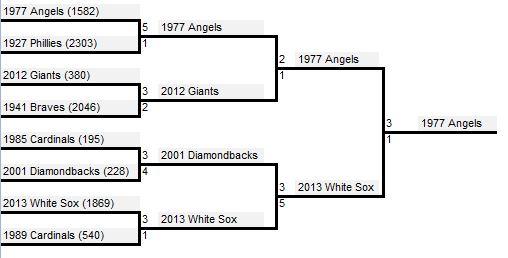
REGIONAL #91:  This group features three pennant winners, a scenario that hasn't occurred since #65, and all three of those teams are ANGRY and ready to rumble. Why angry? Well, the 2012 Giants are seeking to avenge the 2010 team's loss in the finals of the previous regional; the 1985 Cardinals are still boiling about Don Denkinger's call in the World Series; and the 2001 Diamondbacks' Curt Schilling is pissed off about pretty much everything, but especially the Baseball Writers Association. I am fairly confident that the regional will go to one of those three squads, and I'll predict the Dbacks over the Giants in the finals with Arizona's two big starters getting them there and their peak steroid-era offense putting them over the top. The ELO rankings pick the Cards to win the regional, but their first round showdown with the Dbacks clearly looks to be the game of the bracket.  

First round action:

The 1977 Angels lost 88 games and were hardly a contender that year, but they had some talent that included Bobby Bonds, Don Baylor, and Nolan Ryan and they were the official Daniel Brown dark horse regional pick. They certainly compared favorably to the 1927 Phillies, a 51-103 last place team that the ELO rankings had among the 75 worst teams of all time. The Angels begin the scoring in the top of the 3rd when Bonds rips an RBI single through the infield, but a bases-loaded single by Dick Spalding in the bottom of the inning ties the game, with the go-ahead run being cut down at the plate for the third out. In the 5th, a two-out error (the Phils third error of the game) opens the door for a Don Baylor homer, and it's 3-1 Angels. A Terry Humphrey sac fly and a Joe Rudi double put the Angels on top 5-1, and Nolan Ryan is cruising, displaying remarkable control (for him). Ryan ends up with the complete game 5-1 win, allowing 7 hits and just 2 walks, and the Angels move easily to the semifinals.

The 2012 Giants won 94 games and the World Series, and like the 2010 team that lost in the final of the prior regional they had a solid combination of pitching, defense, and hitting, with their main weakness being the lack of a capable DH.  The most noteworthy thing about their opponents, the 62-win 1941 Braves, WAS their DH:  HOFer Paul Waner, who hit only .267 at age 38; the Braves had one decent starting pitcher in Jack Tobin and only one hitter in the lineup with a SLG% over .400, Max West.  Nonetheless, the Braves took an early 1-0 lead in the 1st on a Waner fielders choice, but on the next roll lost West to injury for the remainder of the tournament.  With little now behind him, it's up to Tobin to lock down this game, and he does so until the 5th, when Brandon Belt misses a HR split on Tobin's card but the resulting double drives in the tying run.  Buster Posey also misses the same split in the 6th, but also drives in a run with the double, and Hunter Pence adds an RBI single in the 8th to make it 3-1.  However, when Buddy Hassett leads off the bottom of the 9th with a HR off Cain's card, Cain is pulled for Mijares, who retires three in a row to preserve the 3-2 Giants win.

In the most highly anticipated matchup of the regional, the 101-win NL champ 1985 Cardinals with their speed, defense, and pitching depth faced off against the 92-win World Series champ 2001 Diamondbacks, with their offensive might and Big Two starting pitchers.  Not since Regional #65, where the '71 Orioles slaughtered the '76 Yanks 11-1, had two pennant winners played in the first round, and the pitching matchup was epic:  Cy Young winner Randy Johnson (21-6, 2.49 ERA) vs. Cy Young runner-up John Tudor (21-8, 1.93).  In the top of the 1st, doubles by Vince Coleman and Jack Clark put the Cards up 1-0, but in the bottom of the 1st, after Finley is cut down going home on a Luis Gonzalez double, Reggie Sanders blasts a HR to put the Dbacks up 2-1 and it's game on.  In the 3rd, AAA stealer Coleman singles, steals second, and scores on a Cedeno single to tie the game, but Arizona answers in the bottom of the inning when the Cards uncharacteristically make two errors, leading to Finley scoring on a Sanders fielders' choice, making it 3-2 Dbacks.  Tommy Herr ties it in the 6th singling in Van Slyke, who had doubled, and then both starters bear down and the game goes to extra innings deadlocked 3-3.  Both Johnson and Tudor hold down things in the 10th, and then by tournament rules things get turned over to the respective bullpens.  Byung-Hyun Kim retires the Cards in order in the top of the 11th.  In the bottom of the frame, Jeff Lahti comes in for the Cards and his first pitch is crushed by David Dellucci for the walk-off homer and the 4-3 Dback win; Tudor was last seen in the Cardinal dugout punching various inanimate objects.  The unlikely hero, Dellucci was only in the game because DH Durazo had been pulled for a pinch runner in the 9th.

The 86-win 1989 Cardinals had something to prove after their 1985 champs were eliminated in the prior game, but the '89 version had few of the same parts aside from Ozzie Smith and Vince Coleman.  However, they appeared to have way more useful parts than the 2013 White Sox, a last place team that lost 99 games, had an all-"4" outfield and only had one fielder with a "2" or better rating.  However, the Sox did have Chris Sale on the mound, and he held the Cards in check while the Sox went up 1-0 in the 4th on a De Aza grounder.  After the top of the 9th, the Sox put in all their available defensive replacements to try to hold on to the 1-0 lead, but back-to-back doubles by PH Denny Walling and Willie McGee to lead off the bottom of the 9th tied things up. Sale then struck out the side and the game heads to extra innings.  Both Joe Magrane and Sale make it through the 10th, and then the Cards have a horrifying flashback of the previous game where both teams have to turn the ball over to their respective bullpens in the 11th.  Both Ken Dayley for the Cards and Jesse Crain for the Sox do their jobs for their maximum allotment of innings, and in the 15th inning it becomes Dan Quisenberry against Addison Reed. Finally, in the 16th, Willie McGee mishandles a Keppinger single, and Quiz falls to pieces, allowing three more hits to give the Sox a 3-1 lead.  Reed retires the Cards in order, and the Sox win the 16 inning marathon, with snakebit St. Louis losing their second straight extra-inning game of the regional.

The survivors:

The semifinal pairing the 2012 Giants and the 1977 Angels featured two good #2 starters, Ryan Vogelsong and Frank Tanana, and both were in good form for this game.  A leadoff HR by Bobby Bonds put the Angels up in the top of the 4th, but it was matched by a solo shot from Buster Posey in the bottom of the inning.  Neither team could then muster any offense until the top of the 9th, when the Angels loaded the bases with one out against Vogelsong on a squib single and two walks, but Sergio Romo came in and kept any runs from scoring.  Tanana retires three straight in the bottom of the 9th, and for the third consecutive game in this regional we head to extra innings.  Romo is in fine form, while Tanana is finally pulled after 10 innings having allowed only three hits, handing the ball to Mike Barlow.  Romo hits his inning limit in the 13th, and Mijares (who earned the save in the first round game) comes in and walks the first batter, allows a single to Bonds, and then Pablo Sandoval drops a Don Baylor grounder to put the Angels up 2-1.  So in the bottom of the 13th, the game is up to Barlow and his 4.58 ERA to try to hold off the NL pennant winners, and he retires the side in order to send the Angels to the regional final.  Barlow and Tanana combine for a 4-hitter in the 13-inning marathon, but the Angels face a big challenge as they have little left on the pitching staff for the finals.

No HOF for you!
After a tough 1st round battle against a fellow pennant winner, the 2001 Diamondbacks could be forgiven for taking their semifinal opponent, the punchless 2013 White Sox, lightly; in fact, the Dbacks considered saving big #2 starter Schilling for the finals, but decided that such a move could haunt them if they survived until round 6.  Arizona scored two in the top of the 3rd on RBI singles from Grace and Gonzalez; the Sox responded with a solo HR off Schilling's card from C Tyler Flowers.  In the 4th, Tony Womack pushed a run across with a double, but Sox starter Jose Quintana struck out Grace with the bases loaded to prevent further damage.  In the 5th, the Sox tied the game with a 2-run HR from De Aza, again off Schilling's card, and when Schilling put runners on 1st and 3rd with 1 out, the Dbacks had 1st round winner Kim up in the pen but stuck with Schilling, holding the runner on first in hopes of the DP.  However, Gordon Beckham rolls a gbB and the go-ahead run scores on the fielder's choice.  Kim is then summoned, but in the 8th he allows a solo blast to Conor Gillaspie, and Quintana by this time has Arizona in handcuffs.  Final score:  White Sox 5, Dbacks 3, Quintana with the 6-hit CG, and Schilling with the loss, allowing 11 hits in 6.2 innings, with most of the damage coming off Schilling's own card.


In a regional with three pennant winners, the final pairing of two decidedly mediocre teams, the 1977 Angels and the 2013 White Sox, was rather uninspiring and the matchup of the two #3 starters, California's Paul Hartzell and Chicago's Hector Santiago, didn't exactly promise an epic duel.   Nonetheless, as has been the case for both of these teams in the regional, the pitching was surprisingly solid.  The Angels rattled off three straight hits in the 3rd to score two runs, and a Bonds sac fly in the 5th put the Angels lead at 3-0, while Hartzell was dominating the Sox lineup.  Finally, in the bottom of the 9th, the Sox bats come alive, as they lead off the inning with three straight singles to load the bases.  The Angels survey their pen but decide to stick with Hartzell a little longer; Gillaspie drives in one with a sac fly, Alexei Ramirez pops out, and 37-year old longtime Sox hero Paul Konerko comes off the bench to pinch hit representing the winning run.  But no storybook endings here; Hartzell retires Paulie on a lazy fly ball, and the Angels secure the 3-1 win and only the second regional title (joining 1989) for the Halos.  The regional MVP has to be shared by the Angels pitching staff, who only allowed three runs--one in each game--in the regional.

Interesting card of Regional #91: In the last installment of this feature, I presented a Randy Johnson card where he led the league in both strikeouts and walks, and I pointed out that Nolan Ryan had done this a remarkable SIX times.  Lo and behold, the next regional is won by Ryan's 1977 Angels, and he led the league in both categories by a huge amount--341 K's and 204 walks!  I had to check to see if that walk total was a record in the modern era (since 1901), but it was only the second highest total:  Bob Feller allowed 208 walks in 1938, but he had more than 100 fewer strikeouts than Ryan, meaning that Ryan's combined 545 BB+K in 1977 has to be the highest since 1901.  I can't even imagine trying to bat against him; I wouldn't have left the dugout, but I guess I might not be safe even there!


Thursday, February 11, 2021

REGIONAL #90:  This regional featured a World Series champion, the 2010 Giants, and a host of other competitive teams that promised to make it an interesting bracket. The 1975 Orioles were in between pennant wins at the beginning and the end of the 70s and looking for a second straight regional win for this franchise; the 1966 Tigers would capture the flag two years later after a near miss in 1967; and two Pirates teams 40 years apart feature some weapons that make them interesting dark horses. The 1958 Cardinals will try to avenge the 1957 squad that was eliminated in the 2nd round in the last regional, while the 1992 Mariners seek the first regional title for any Seattle team, although the ELO ranks indicate that they were the worst team in the majors that year. I picked the pennant winning Giants over the Tigers in this one; the ELO rankings (in parentheses below) portray a very different outcome, predicting the Orioles will best the 1991 Pirates in the finals. I was surprised when I looked up the ELO ranks to discover that those rankings had the WS champion 2010 Giants as only the 5th best team in baseball that year, while the 1991 Pirates were pegged as the top MLB team that year despite being eliminated by the Braves in the NLCS.


First round action

As I expected, the 90-win 1975 Orioles had a strong starting rotation and excellent defense (Brooks Robinson, Belanger, Grich, Blair all "1"s), but aside from Don Baylor their offense was unexpectedly weak:  for example, Mark Belanger, as usual, hit .226, but that was still better than Blair and Robinson!  Their opponents, the 1958 Cardinals, only managed 72 wins but had more offensive weapons--including Stan Musial-- than the Orioles, albeit nowhere near the pitching and defense of the O's.  However, the Cards started off quickly against 23-game winner Jim Palmer, rapping 3 singles in the top of the 1st but scoring only one run as Belanger turns a great double play.  Belanger somehow makes back-to-back errors in the 2nd, but the Cards can't convert, and the game remains 1-0 until the bottom of the 4th, when a hit and a couple of walks by the Cards' Vinegar Bend Mizell loads the bases for the bottom of the O's lineup.  Blair converts a SI 1-8 off Mizell's card to tie the game, and with the bases still loaded Robinson misses Mizell's HR 1-9 split, but the resulting double scores the fleet Blair and the O's lead 4-1.  Palmer seems to have settled down, but in the 7th he loads the bases for the heart of the Cards order, and singles by Musial and Boyer tie things up.  Baltimore responds immediately, with Jim Northrup missing Mizell's HR split to put runners on 2nd and 3rd with nobody out, and St. Louis summons Morrie Martin from the pen, with no complete hits on his card, but quite a few walk results.  And the O's hit those walk results enthusiastically; Martin issues a walk to load the bases, and then two more walks drive in two more.  Obviously, at that point Martin is gone, and Phil Paine comes in and adds to the pain with an error and another walk, and the score is 8-4 after an eventful 7th inning.  The events continue in the 8th, with the Cards getting a 2-out walk and single before rookie Curt Flood converts a HR 1-7 split off Palmer's card to narrow the gap to 8-7, but two more walks from Paine and a Lee May single pushes the Baltimore lead to 9-7 after 8.  With Palmer getting battered, the O's eye their bullpen for the 9th, but how do you pull a HOF pitcher in one of his best years with a lead?  Sure enough, Palmer allows 2 hits in the 9th, but gets PH Wally Moon to groundout to Brooksie, and the Orioles move on with a hard-fought 9-7 win.

The 64-win 1951 Pirates were largely a two-man show; in the starting rotation, Murray Dickson won 20 games and nobody else won more than 9, while on offense Ralph Kiner's 1.079 OPS dwarfed the rest of the team by a wide margin.  In contrast, the 88-win '66 Tigers had multiple weapons in both areas, with Earl Wilson tapped for the start over formidable alternatives like Denny McLain and Mickey Lolich.  The Pirates found some weaknesses on Wilson's card quickly, loading the bases in the top of the 1st and scoring a run on a Joe Garagiola sac fly.  That lead didn't last long, as homers by Al Kaline and Willie Horton in the bottom of the 1st made it 3-1, and a 2-run single by Norm Cash in the 3rd extended the Tigers' lead to 5-1.  A 2-base error by Horton leads to a Pirate run in the 5th, and in the 6th Wilson falls apart after allowing a 3-run pinch hit homer to Erv Dusak off Wilson's card; when the flames subside Fred Gladding is on the mound and the Pirates lead 7-5.  The Tigers counterpunch with a Don Wert solo HR in the bottom of the 6th, and then in the 7th a 2-base error by Pirates SS Strickland is followed by consecutive doubles from McAuliffe and Kaline.  At that point, the Pirates pull Dickson for their best reliever, Ted Wilks, and Norm Cash greets Wilks with a prodigious blast into the far reaches of Tiger Stadium.  Wilks allows three more hits in a row, and by the end of the inning the score is now Tigers 12, Pirates 7.  With a solid lead, the Tigers dig deeper into their pen to preserve Gladding for later rounds, and Orlando Pena tosses two perfect innings to close things out, sending the Tigers into the 2nd round with the comeback win.

Setting the lineup for the 92-win 2010 Giants pennant winners helped me understand why the ELO rankings for the team weren't better despite their World Series title; they were pretty good in most categories, but not really great in any.  Their much lower ranked opponent, the 1992 Mariners, lost 98 games but in Griffey Jr. had a bigger offensive weapon than anyone on the Giants, and the M's were better defensively than the Giants, although their starting rotation was cringeworthy, featuring a young Randy Johnson who had lots of velocity but no aim.  Johnson and his counterpart, Tim Lincecum, keep things scoreless until the top of the 5th, when the Giants score five runs on only two hits, aided by 2 Mariners errors and 3 walks (2 with the bases loaded).  However, in the 7th Seattle gets to Lincecum, with Henry Cotto, in the game for his glove, hits a 2 run HR and Edgar Martinez adds an RBI double and it's now 5-3, with Casilla summoned from the bullpen to close out the inning.  The Giants add an insurance run in the 8th on a Posey RBI single, and in the bottom of the 9th they turn it over to Beach Boy closer Brian Wilson, who strikes out the side to seal the 6-3 win with an exclamation point.

The 1991 Pirates won 98 games and the NL East, and were a well-balanced team with good pitching in the rotation as well as some in the pen, a defense that had 6 of 8 positions either a "1" or a "2", and a lineup featuring Barry Bonds and Bobby Bonilla when they were good but not yet infamous. In contrast, the 89-loss 2012 Blue Jays had little to brag about aside from Edwin Encarnacion's 42 homers. That didn't prevent Jose Bautista from putting a 2-run homer into the cheap seats in the top of the 1st against the Pirates' 20-game winner John Smiley, but an RBI double from Bonilla in the 1st and a timely single from Mike Lavalliere in the 2nd quickly tied the game at 2-2. The Jays push back ahead in the 4th with solo shots from Encarnacion and catcher J.P. Arencibia, while Toronto starter Brandon Morrow is settling in and the Pirates can't convert hits to runs. Smiley yields to Roger Mason in the 7th, who prevents further damage for Pittsburgh, but the Pirates don't muster a real threat until the bottom of the 9th, when a Buechele walk and a PH single from Lloyd McClendon puts the winning run at the plate, but #9 hitter Jose Lind pops out to give the Jays the upset 4-2 victory over the ELO regional favorites. Unfortunately for Toronto, Morrow was by far their best starter as a swingman, and they lost both LF Rajai Davis and DH David Cooper to injury, meaning they'll have to play the semifinal game undermanned and undertalented against a pennant winner.

The survivors

A semifinal matchup between the 1966 Tigers and the 1975 Orioles was accurately predicted by the ELO rankings, but although those ranking favor the Orioles here, after setting the lineups in round 1 I was sticking with my pick of the Tigers in this pairing, as I believe they have more offensive weapons and a starting rotation arguably as good as Baltimore's.  Not many 2nd round games feature two 20-game winners squaring off, but that was the case with Mike Torrez vs. Denny McLain.  The game was scoreless until the 4th, when a couple of hits and a Torrez 2-base error led to 3 Tiger runs, but the Orioles knotted the game in the 7th when McLain loaded the bases with nobody out; Baylor fanned but Lee May drove in 2 with a single and Grich added another to tie things up.  Grich provides more heroics in the top of the 9th, driving in Baylor to put the O's ahead.  Torrez then tries to close things out; he walks Freehan but gets two quick outs, and faces PH extraordinare Gates Brown as the potential winning run.  But Brown grounds out, Torrez completes a 6-hit complete game, and the Orioles move to the regional finals with the 4-3 comeback win.  Worthy of note:  Jim Northrup was in the starting lineup for both teams at ages 26 and 35, the latter being his final year.

When facing a World Series champ in this tournament, I've discovered that it's much better to do so in the 1st round than in later rounds, because by then the pennant winner almost always has a much better starting pitcher available.  That was the case with the champion 2010 Giants' Matt Cain against the 2012 Blue Jays and Carlos Villanueva, and the Giants drove home the point with two 1st inning homers from Freddy Sanchez and Aubrey Huff, and a Pablo Sandoval double in the second that made it 5-0 Giants before the Jays could even get anyone on base.  Jose Bautista gets the Jays on the board with a 2-run HR in the 4th, but Pat Burrell's solo shot in the 5th makes it 6-2.  When Villanueva allows a double (off a missed HR split on his own card) to lead off the 6th, he's pulled for Darren Oliver, but another double for Sandoval makes it 8-2 Giants, and that's how it ends.  Cain gets the 6-hit complete game victory, and the Giants head to the finals aiming to capture an impressive 8th regional win for this franchise.

This regional final thus matched the ELO favorite 1975 Orioles against my pick, the pennant winning 2010 Giants, and it looked to be the strong defense of the Orioles against the superior offense of the Giants.  The two starters, Mike Cuellar and Jonathan Sanchez, were both top-flight #3 options and the game remained scoreless until the top of the 5th, when a key Aubrey Huff error followed by a gbA+ single set the plate for a 2-run Ken Singleton double.  The Giants had never been behind in this tournament before, and they got further behind when Belanger singled home a run in the 6th when his SS counterpart Uribe couldn't get to the ball.  The Giants made it 3-2 in the 7th when Cody Ross hit a 2-run homer off Cuellar's card, and when Don Baylor led off the 8th with a double the Giants went to closer Brian Wilson to try to keep them in the game--with Wilson retiring the side without incident.  Similarly, Cuellar exits in the bottom of the 8th after allowing a leadoff double and the O's turn it over to Dyar Miller to try to convert the save--and like Wilson, Miller retires the side quietly.  In the top of the 9th, Giants LF-4 Pat Burrell allows a leadoff single, and Paul Blair follows with a triple on a 1-4 split off Wilson's card to provide an insurance run, and the Giants can do nothing against Miller in the bottom of the 9th, giving the Orioles the 4-2 win and the second regional title in a row for the franchise--meaning that the 1975 Orioles will face their 2013 counterparts in Round 4 of the tournament.

Interesting card of Regional #90:  This card shows what it's like when your pitcher leads the league in both strikeouts and walks allowed.  I put Johnson in with the likes of Nolan Ryan and Sandy Koufax as big strikeout guys who took a while to learn the control necessary to become great pitchers.  Although Koufax never led his league in both walks and strikeouts, Ryan did it a record-setting SIX times. In researching this, I was surprised to discover that 19 other pitchers have done it since 1901, including a number of Hall of Famers.  Can you think of some?


Wednesday, February 3, 2021

 REGIONAL #89:   This regional included no pennant winners, although the 1969 Tigers had a great Series champion team the prior year and I figured that the 1934 A's probably still had many of the assets from their 1929-1931 dynasty.  In addition to those teams, the regional should include other great names such as Ted Williams and Stan Musial.  Although I didn't expect much threat from the steroid era teams, they tend to overperform, but nonetheless I picked the Tigers over the A's in the final.  The ELO rankings agreed with me on the Tigers being the favorite, but suggested that I was underestimating the 2003 Cubs.

First round action

In setting the lineup for the 1934 A's, I discovered that this team had undergone serious dismantling since its dynasty of only a few years earlier.  Gone were Cochrane, Grove, Simmons, Earnshaw, Bishop and the like; only Jimmie Foxx remained as a significant factor, and he had a great season.  However, with a dreadful starting rotation and few weapons other than Foxx, the team only won 68 games.  The A's faced a modern era team famous for frequent dismantlings, the 2010 Marlins, who won 80 games with several weapons and a starting pitcher, Josh Johnson, who looked like Cy Young compared to anyone on the A's staff.  Nonetheless, a 1st inning 2-run HR by Bob Johnson quickly put the A's up 2-0, but a solo shot by Marlins RF "Mike" Stanton to lead off the 2nd narrows the lead to 2-1--although Stanton is injured and leaves the game in his next plate appearance.  Doc Cramer's RBI single makes it 3-1 A's in the 4th, but Josh Johnson settles down and in the 7th the Marlins finally locate the numerous weaknesses on A's starter Bill Dietrich's card, as he loads the bases with nobody out.  With one run already in, the A's summon George Caster, who induces a double-play grounder, but then grooves one to super pinch-hitter Donnie Murphy who puts it into the stands for a 4-3 Marlins lead.  The Marlins pull Johnson in favor of Clay Hensley after he allows a leadoff single in the 9th, and Hensley retires three in a row to earn the save for the 4-3 Marlins win.  Worthy of note:  After setting the Marlins lineup, as usual I do a quick check of Baseball Reference to see if I'm missing anything, and I discover that rookie Giancarlo Stanton was in RF for the Marlins in 2010.  Shuffling through the team, I find that he's not there, and I panic about a missing card.  Then I look in the lineup that I've already set and notice that this Mike Stanton guy out in RF has the same stats as Giancarlo.....duh.

Not a single single
The 88-win 2003 Cubs won the NL Central and came within one game of a pennant--an NLCS game altered by fan Steve Bartman that added to the persecution complex of Cubs fans everywhere, at least until 2016.  The 2003 squad featured a steroid-era lineup that included poster-boy Sammy Sosa, but also a starting rotation that was remarkably strong for the era, with dominating Kerry Wood getting the start.  They faced another Cubs team of a different vintage, the 1949 Cubs, who only won 61 games but had many of the same players as the Cubs squads who had played over their heads to reach the finals in Regionals #86 and #87, including tabbed starter Bob Rush who had gone 2-0 in those regionals.  The 49ers got off to a quick start when DH Hank Edwards drove in a run with a triple in the bottom of the 1st, but in the top of the 2nd the '03s evened it up when Sosa led off with a solo blast onto Waveland Avenue.  In the 5th, the 03's moved on top when SS Alex Gonzalez hit his first of 2 doubles to drive in Simon and make it 2-1, and Wood was cruising until the 8th.  However, in the bottom of the 8th, Gonzalez turned a leadoff grounder into a 2-base error, and Wood followed that with two walks to load the bases with none out.  Wood fans Roy Smalley, and then it's another tough grounder to SS Gonzalez--and he turns the double play to atone for his earlier error.  Then, in the bottom of the 9th, Gonzales commits another error on a leadoff grounder, Frankie Gustine doubles the runner home, and pinch hitter Phil Cavaretta hits a squib single to make it 1st and 3rd with nobody out.  The 03s bring the infield in to prevent the winning run from scoring, and Emil Verban rolls the gbA+ through the infield to score Gustine, giving the '49 Cubs the 3-2 walk-off win and Bob Rush his third victory of the tournament for the Cubs of this era.

The first round matchup of the 90-win 1969 Tigers and the 87-win 1957 Cardinals involved two 2nd-place teams that were two of the regional's best, according to the ELO rankings. Both squads had numerous weapons throughout the lineup, although the Tigers boasted a much better rotation than the Cards, and the faceoff of 24-game winner Denny McLain vs. Lindy McDaniel clearly favored the Tigers. The Tigers jumped to a quick 2-0 lead in the 1st on a Willie Horton double, and then a bases-loaded single in the 3rd scored another 2 when Cards RF Del Ennis couldn't get to a Don Wert single. However, when Tigers SS Tom Tresh (what was he doing playing short in 1969?) booted a 2-base error to lead of the top of the 4th, McLain came unglued, allowing 4 runs (2 on a Ken Boyer homer--what was he doing playing CF in 1957?) and the game was tied 4-4. A Kaline solo shot in the bottom of the inning put the Tigers back on top 5-4, but McLain can't recover his form, getting mauled in the 6th for 5 runs (including a 3-run blast by Stan Musial) and McLain is yanked with a line of 5.2 IP, 12 HA, 9 RA. Buoyed by the 9-5 lead, McDaniel gets down to business and the Tigers are held scoreless until the bottom of the 9th, when Dick McAuliffe leads off the inning with a solo HR. The Cards eye their solid bullpen, but decide to give McDaniel the chance to close out the game, and he does, with defensive replacement CF Bobby Gene Smith hauling in a deep Horton fly to complete the 9-6 Cardinal win.

This pairing of two 3rd-place teams, the 79-win 1958 Red Sox and the 85-win 2013 Orioles, matched squads with some serious offensive might (e.g., Ted Williams vs. 53-HR hitting Chris Davis) but both had poor starting rotations that probably kept them from reaching the post-season.  Orioles starter Scott Feldman started terribly, allowing a leadoff single in the 1st followed by three consecutive walks, and he was fortunate to escape the inning only down 2-0.  Baltimore C Matt Wieters nailed a solo shot in the 3rd to narrow the gap to 2-1 Boston, but after that both starting pitchers were surprisingly effective.  When Feldman walked the first 2 batters in the top of the 9th, the O's pulled him for Darren O'Day, but a single by Don Budden provided an insurance run so the game goes into the bottom of the 9th with Boston ahead 3-1.  Red Sox starter Frank Sullivan allows a leadoff double to Nick Markakis, and there is activity in the Boston bullpen; with Chris Davis up, the Sox leave Sullivan in pitch to him rather than walking him to put the tying run aboard.  Of course, BOOM, Davis bounces it off the RF warehouse at Camden Yards and the game is tied; Leo Kiely comes in for the Sox and we head to extra innings.  O'Day retires Boston in the top of the 10th; Kiely begins the bottom of the 10th by allowing consecutive doubles to Wieters and replacement 2b Ryan Flaherty, and the Orioles score the walk-off 4-3 win.  Key stat:  Ted Williams records 3 walks and a double that resulted from missing a HR 1-14 split, but the Sox were never able to drive him home.

The survivors

The semifinal between the 2010 Marlins and the 1949 Cubs was a dogfight between two flawed but plucky teams.  Dan Uggla took Cubs starter Monk Dubiel deep for a 2-run homer to put the Marlins up in the top of the 1st, and they added another run when Logan Morrison hit a solo shot (this one off Dubiel's card) in the 2nd.  However, a 2-base error by Marlins CF-2 Cameron Maybin in the bottom of the inning opened the floodgate for a 3-run rally against Marlins' starter Anibal Sanchez, and the game was tied after two.  In the 3rd, Hanley Ramirez finds Dubiel's homer result again to put the Marlins up 4-3, but in the 4th an Emil Verban single with runners on 2nd and 3rd ties it--with the go-ahead run cut down at the plate.  In the 7th, the Cubs examine their bullpen but there is no help there, and sure enough Marlins LF Chris Coghlan finds Dubiel's HR reading for the 3rd time this game, and it's 5-4 Florida.  In the bottom of the 8th, Sanchez walks the first two Cubs and the Marlins summon Clay Hensley for the second game in a row--Hensley then tosses two perfect innings to record his second straight save and the Marlins head to the finals.   The good news for the Marlins is that Stanton will return from injury for the finals; the bad news is that Hensley is burnt and there is nothing but trouble remaining in the Marlins' starting rotation.

The 2013 Orioles had a last second come-from-behind win in the first round, so in battling the 1957 Cardinals they decided to take a different approach, jumping to a quick 2-0 lead in the 2nd on back-to-back solo HRs by Nick Markakis and Chris Davis, and another solo shot by Matt Wieters in the 3rd made it 3-0.  Meanwhile, O's starter Chris Tillman was looking good until the top of the 7th, when Stan Musial and Wally Moon added back-to-back solo shots of their own, and it was 3-2 Orioles with every run scored on a solo homer.  Given the balls flying out of Camden Yard, both teams went to their best relievers in the 8th; Darren O'Day makes his second appearance of the bracket and retires the Cards in order in the top of the 8th, but Billy Muffett gets raked over the coals by the bottom of the Baltimore lineup, and after RBI singles from Hardy, Machado, and Roberts it was now 6-2 O's.  O'Day sets the Cards down quietly in the 9th to earn his second save, and the Orioles move to the finals to face the Marlins, with both franchises each only having one prior regional win.

Defense and offense
The finals for the regional matched two battle-tested teams, the 2010 Marlins and the 2013 Orioles, that both had survived tough games in the first two rounds.   The 2nd inning matched solo HRs from Florida's Jorge Cantu and Baltimore's Danny Valencia, and things remained knotted until the 5th when a Cameron Maybin sac fly made it 2-1 Marlins.  A 2-run shot from Gaby Sanchez in the 6th stretched the lead to 4-1, and Marlins starter Chris Volstad was in control, aided by unexpectedly good defense from the likes of Cantu (3b-5) and Uggla (2b-4).  In the bottom of the 8th, Volstad had to face monster Chris Davis as the tying run with two men aboard, but got Davis to fly out to end the inning.  After going scoreless in the top of the 9th, the Marlins put in whatever defensive replacements they could find to bolster Volstad for the bottom of the 9th, but Volstad led off with a walk and two consecutive singles, and the Marlins had to summon their best remaining reliever, Brian Sanches, to close things out with nobody out and the tying run on 1st.  Sanches fans Manny Machado, and then faces Matt Wieters, the Orioles outstanding defensive catcher who had homered in both previous games.  Here's the pitch: a 6-5 roll, HR 1-17 on Sanches' card--inning, game, regional over.  Wieters 3-run blast gives the Orioles the 5-4 win, a second regional title for the Orioles, and their second walk-off win in three games.  Wieters is the obvious choice for regional MVP, but honorable mention should go to the Orioles collective defense, more than half of whom were "1" fielders and who did not make a single error in the regional to help shore up a shaky starting rotation.


Interesting card of Regional #89
:  This was a tough selection, as I was sorely tempted to put up 2003's Kerry Wood, who didn't have a single SINGLE reading on his formidable card (see above), or 2010 Marlins' Donnie Murphy, whose 2010 card boasted a .705 SLG% in 44 ABs and every result was pretty much either an extra-base hit or a strikeout.  However, it was the 2013 Orioles who won the regional in dramatic style, and so I felt compelled to honor their big bat, Chris Davis.  Because I am an old-school Strat player who greatly prefers the old Basic card patterns, Davis's card is a nearly perfect thing of beauty to me, marred only by that ghastly 2-9 result that is the type of gaping wound found on so many modern hitting cards.  Even so, I still wouldn't mind putting this guy at first on my team.