Monday, August 23, 2021

REGIONAL #107:  This regional featured no pennant winners but had versions of the Rangers, Giants, and Mets who were building towards one, and a Yankees team that was just coming off a string of legendary winners.   Given the way that the 1934 Yanks had blown through Regional #97, it seemed to me that the 1930 version was likely to be even better with Ruth closer to his prime, so I picked them over the 2008 Rangers in the finals.   The ELO ranks agreed that the Yanks were a no-brainer favorite, identifying the Bronx Bombers as really the only good team in the regional--a designation that often turns out to be the kiss of death.


First round action:

The 1990 Expos won 85 games and struck me as a decent team, with many good players but who were not having their best years.  They did have lots of team speed, with four AA stealers, and Dennis Martinez had a good season and represented a formidable #1 starter.  They faced a 79-win 2008 Rangers team that had some eye-opening hitters (5 guys in the starting lineup with over .500 SLG%) and painfully bad starting pitching, so you had the feeling that those 79 wins were probably high-scoring affairs.  But it’s the Expos who start off the fireworks, with Larry Walker and Mike Fitzgerald each hitting solo HRs in the 2nd--off their own cards, not Ranger starter Vincente Padilla’s, who gives up quite a few of his own.  The Rangers respond in the bottom of the 2nd, with a two-out David Murphy single scoring Milton Bradley, and it’s 2-1 Expos.  The Montreal team speed results in a run in the 3rd when Deshields walks, steals second, and scores on a Tim Wallach single, but the wheels come off for Martinez in the bottom of the inning when he loads the bases and then allows the grand slam to Bradley off the pitcher’s card, and the Rangers lead 5-3 after three in what is promising to be a slugfest.  Sure enough, Galarraga blasts a 3-run shot off Padilla’s card in the 6th and the Expos reclaim the lead, and when Otis Nixon walks and steals second in the 7th, the Rangers leaf through their bullpen and select Frank Francisco as the best option.  Francisco is masterful, but the Rangers come down to their last chance in the bottom of the 9th still down by a run.   Martinez records two quick outs, but then Ramon Vasquez finds Martinez’ HR result, gets the split, and ties the game with a solo shot.  Ian Kinsler follows with a double, and the Expos summon Steve Frey to try to keep the winning run from scoring.  What happens next is a strange confluence of events.  Frey has to face Hank Blalock, only in at DH because Milton Bradley (he of the grand slam earlier in the game) had suffered a minor injury in the 8th that knocked him out of the game.  Blalock rolls the 5-10--the same number that Vasquez and Bradley had rolled on Martinez’ card for the HRs, but there is no HR there on Frey.  Instead, it’s a GB(3B)X...however, because Tim Wallach (3B-1) had suffered a minor injury that had knocked HIM out of the game in the 8th, Junior Noboa (3B-4) was in there as the Expos' only option.  Result:  2 base error, Kinsler scores the winning run on the error, and the Rangers move on to the semis with the 7-6 comeback/walkoff win.

Two fairly bad teams faced off in this first round game, with the 78-win 2002 Reds paired against the 1981 Mets who went 41-62 in that strike year.  The Reds strike first in the 3rd inning when Adam Dunn sends a Mike Scott scuffball into the far reaches of Shea Stadium to give Cincinnati a 2-0 lead, and Ken Griffey Jr. adds a solo shot in the 4th to make it 3-0.   Meanwhile, the Mets don’t get their first hit off Reds starter Elmer Dessens until the 6th when Lee Mazzilli singles, steals second, and scores on a Mookie Wilson base hit to narrow things to 3-1.   The Reds get that run back in the top of the 7th on a solo shot by PH Brandon Larson.  When Scott allows an RBI double to Todd Walker in the 9th, Terry Leach comes in, but by then it’s too little too late as Dessens closes out his 5-hit CG in the bottom of the 9th and the Reds head to the semis with a leisurely 6-1 win.

I was looking forward to exploring the 73-81 1949 Giants, being quite familiar with the legendary 1954 old-timers team as well as the ‘51 playoff winners, but also knowing that Willie Mays wouldn’t begin his long tenure in CF until the following season.   Turns out that the Giants weren’t quite yet ready for prime time, with a weak infield and so-so starting pitching, with Dave Koslo getting the nod for the first round.  However, they faced the worst rated team in the regional in the 51-64 1994 Marlins, who were only in their second year of expansion existence and had their season mercifully shortened by the players’ strike.  Things don’t go the Marlins’ way quickly, as their best hitter Gary Sheffield is injured for 4 games in his first plate appearance.  Then, in the 2nd Marlins starter Pat Rapp issues 3 straight walks, followed by a GBX to 3b-4 Jerry Browne (who apparently could field 5 positions about as well as the former Governor of California) that turns into a double, and the Giants lead 3-0.  A Jack Lohrke fielder’s choice scores another run in the 3rd, and when Rapp issues a bases loaded walk in the 4th inning to Bobby Thomson, Rapp’s 3rd BB of the inning, he’s replaced by Luis Aquino, who ends the inning without further damage, but it’s now 5-0.  The Marlins put up a run on a Kurt Abbott solo shot in the bottom of the 4th, and get another one in the 5th when Greg Colbrunn pushes an RBI single past Giants 2b-4 Hank Thompson, and the sparse crowd at Joe Robbie Stadium is starting to show signs of interest in the game.  However, in the 7th Bobby Thomson rips a triple followed by a Lohrke sac fly, and the Giants hold the 6-2 lead at the 7th inning stretch.  Unfortunately, in the bottom of the inning that stretching seemed to injure the Marlins replacement for Sheffield, Carl Everett, and he’s out of the game, and Florida is trying to talk some of the few remaining fans into playing RF.  However, the Marlins put together a 2-out rally in the bottom of the 8th, with a Chuck Carr single and a Johnny Mize error leading to two Florida runs, and we have a game entering the 9th inning, with the score now 6-4.  The Giants promptly get to Marlins new reliever Robb Nen for two more runs, keyed by a Bobby Thomson double, and it’s up to Koslo to hold the Giants lead as there isn’t much help in the pen for New York.   He sets the Marlins down in order, and the Giants move on to the semis with the 8-4 win.

With Ruth and Gehrig in their primes and a remarkable 9 Hall of Famers on the team, it was remarkable that the 1930 Yankees only managed to win 86 games to finish 3rd in the AL.  Their opponent, the 2008 Braves, lost 90 games but they did have two carded HOFers of their own--Chipper Jones who had a monster year, and a 42 year old Tom Glavine who was ineffective and retired after the season.   The Yanks were starting one of their HOFers in Red Ruffing, and they had the added incentive for payback in that the vaunted 1927 Yanks had been eliminated from the tournament by a Braves team.   The Yanks flex their muscles early when in the bottom of the 1st Earle Combs doubles, and Braves starter Jarr Jurrjens walks both Gehrig and Ruth wanting no part of pitching to them.  However, Ben Chapman makes him pay by slicing a triple into the corner to score three, Bill Dickey singles Chapman home, and it’s 4-0 after one inning.  The Braves show some life in the 2nd when Mark Kotsay triples and scores on a Kotchman sac fly, but the Yanks punish them in the bottom of the inning with 3 straight 2-out hits that include another Combs double and a Gehrig triple, and the score is now 6-1.  Two more NY runs in the 3rd and Jurrjens has to be removed to preserve his sanity, and the Braves summon Will Ohman from the pen, as in “Oh man, can’t you pitch somebody else?”  Chipper Jones scores on a Kotchman fielder’s choice in the 4th to make it 8-2, Ohman pitches four shutout innings, but the brief glimmer of hope for the Braves fades when Combs triples in Harry Rice in the 8th off Ohman’s replacement, Buddy Carlyle.  However, Ruffing can’t get the CG as he is injured for 2 games in the 9th, leaving the Yanks to pull something out of an atrociously bad bullpen.  They go with Roy Sherid and his 5.23 ERA as the best option, and he records the final two outs as the Yanks cruise to the semifinals with the 9-2 win.

The survivors

Milton Bradley gaming
The 2008 Rangers had persevered with two comebacks in their first round win, but they burned their best reliever in the process and in this semifinal they were now forced to dip deeper into an extremely shallow rotation, with Kevin Millwood getting the start.  Fortunately for them, the 2002 Reds had an even poorer ELO rank and their starter, Jimmy Haynes, wasn’t much to write home about either.  The Reds start the scoring in the bottom of the 1st with an Adam Dunn solo HR off Millwood’s card, Dunn’s second dinger of the regional.   That lead is extended in the 2nd when Griffey Jr. hits HIS second HR of the regional, a 2-run shot also off Millwood’s card, and it’s 3-0 after two.  In the 3rd, the Rangers rack up three hits but only score one on Milton Bradley’s RBI single, but in the 5th Bradley nails a 2-run blast off Haynes’ card to knot the game at 3-3.   In the 6th, back to back doubles by PH Taylor Teagarden and 3b Ramon Vasquez put the Rangers on top, and two batters later Nelson Cruz contributes a 2-run double that sends Haynes to the showers in favor of Scott Williamson, but the Rangers now hold the 6-3 lead.  For added insurance, Josh Hamilton crushes a 2-run blast in the 9th, and Millwood recovers from his shaky start, only allowing one hit in the final five innings to earn the Rangers the 8-3 win and a spot in the regional final.

Both the 1930 Yankees and the 1949 Giants won their first round games easily, but each team expected a greater challenge in their Subway semifinal matchup.   It was the Yanks’ George Pipgras against the Giants’ Sheldon Jones on the mound, and it was the Giants who struck quickly against Pipgras in the top of the 1st, with Sid Gordon singling in Hank Thompson for a 1-0 lead.   Jones shackles the Yanks until the 5th, when Lyn Lary, the least likely slugger on the the team, nails the HR split on Jones’ card to tie the game, but the Yanks are stymied in the 6th when Dickey misses a TR 1-8 with a 9, and Chapman (1-17 with 2 out) is nailed at the plate on the resulting double to end the inning.  The splits are more fortunate for the Giants in the 7th when Whitey Lockman gets a double on a 1-3 split and then gets the split to score on Bobby Thomson’s single, and they regain the lead 2-1.   Facing the top of the Yankee order in the 8th, Jones insists on pitching to Ruth with 2 out and Jimmy Reese on 3rd, and Jones gets Ruth to hit a grounder to Sid Gordon, 3b-4, who boots it and allows the tying run to score.  Pipgras sets the heart of the Jints lineup down in order in the 9th, and then Jones, facing the bottom of the Yankee order in the bottom of the 9th, has Harry Rice find Jones’ HR result, Rice gets the split, and the Yankees get the walk-off, come from behind 3-2 victory to earn a trip to the regional final.  It’s worth noting that the powerful offense of the Yanks scores all of its runs off Giants’ pitching and defensive lapses.

The 2008 Rangers had no options other than Scott Feldman to pitch the regional final, giving him the unenviable task of facing the 1930 Yanks Murderer’s Row lineup and Herb Pennock on the mound, but Texas had come back from deficits in both previous games proving that they were not easily daunted.  Sure enough, they begin the game with two straight singles and a sac fly from Nelson Cruz and take an early lead, but the Yanks load the bases in the bottom of the 1st and tie it up on a Ben Chapman sac fly.  A David Murphy solo shot puts the Rangers back up in the 2nd, but that lead is equally short-lived as Josh Hamilton misplays a Lazzeri single, and Harry Rice drives Lazzeri home to knot the score at 2-2 after 2.  Rice goes down to injury in the 4th, replaced by Sammy Byrd, but the Rangers run into some bad luck of their own when Cruz lines into a triple play to bring a quick end to the 5th inning.  When Feldman allows a walk and a single to start the 6th inning, the Rangers waste no time in bringing in Frank Francisco, their relief hero from the first round win, and they get their money’s worth as Francisco retires three in a row to keep the game tied.  However, the Yanks do pull ahead in the 7th when, with runners on 1st and 3rd and the infield back, Ian Kinsler fails to complete a DP that allows Combs to score from 3rd.  When the Rangers load the bases with one out in the 8th, the Yanks remember the previous inning and bring the infield in for Chris Davis, who promptly rolls the gbA that would have ended the inning--but Hamilton whiffs anyway and the Yanks escape still holding the one run lead.  The Rangers begin their last chance in the 9th with a David Murphy double, but Pennock bears down to retire the next three in order, aided by two great fielding plays from ss-3 Lyn Lary, and the Yanks squeak out the 3-2 win to capture the regional--without a single long ball from either Ruth or Gehrig in any of the games. Worthy of note: this was the first time since Regional #94 that I accurately predicted the result of the regional final, including which teams would be playing. 

Interesting card of Regional #107:  As much as I wanted to highlight Babe Ruth for this feature, the Yanks won the regional with almost no contribution from the Bambino, with no homers or RBI in support of his teammates.   Plus, by the end of the regional final, the Babe didn’t even have the best HR card in the game.   No, that honor belonged to this pinch hitter, Taylor Teagarden, who is probably somewhat lower on the household name scale than Ruth.   This was Teagarden’s first Strat card, and it was steeply downhill from there; his .2008 SLG of .809 never got higher than .374 again, and his .319 BA never exceeded .235 in subsequent years.  His career came to an ignominious end in 2016 when he was handed an 80 game suspension for PED use, and he never played in the majors again, after a career in which he hit 21 homers.  Even so, for these 47 brief, shining at-bats, Teagarden could stand shoulder to shoulder with the Babe.


Saturday, August 14, 2021

REGIONAL #106:  For the 3rd regional in a row, there were no pennant winners in this group of eight, but five of those teams were within 4 seasons of winning their league, including three NL teams from the 50s:  the Braves, Reds, and Dodgers.   With four of the aforementioned contenders comprising the bottom half of the bracket, I had a feeling that the squad that could survive there would take the regional, and on a whim I picked an all-Dodgers final, with the ‘57 Dodgers prevailing over the 2006 version.  The ELO ranks also selected the ‘57 Dodgers as the favorite, with the ‘53 Braves expected to face them in the finals.

First round action

The 78-win 1987 Mariners and the 75-win 2003 Pirates had similarly mediocre ELO rankings and had many other things in common--a core of solid players, several holes in the lineup, and each had exactly one really good starting pitcher:  Mark Langston for the M’s, Kip Wells for the Pirates.  The Pirates also had an additional handicap in that they seemingly traded a number of key parts of their team before the end of the season, meaning that Strat carded those players on other teams and left the Pirates bereft of quite a few at-bats.   However, the Pirates didn’t look too handicapped when Reggie Sanders blasts a 2-run HR in the bottom of the 1st, and Seattle also gets to play shorthanded when RF Mike Kingery is injured for the remainder of the game in the 2nd.  Langston then issues two walks in the bottom of the 2nd, and yields a 3-run shot by Tike Redman off Langston’s card, and the Mariners are looking at a 5-0 deficit after two innings.  Seattle scores a run in the 3rd on a Phil Bradley fielders’ choice, and in the 5th their other Bradley, Scott, contributes a sac fly and the M’s are trying to climb back into the game.  They clearly do so when Jim Presley finds Wells’ HR result in the 6th for a 2-run dinger, and now the Pirate lead is only 5-4 and Langston seems to have recovered his stuff, only to falter and allow an RBI single to Craig Wilson in the bottom of the inning to make it 6-4.  Wells allows 2 hits to lead off the 8th, and Pittsburgh eyes the bullpen but doesn’t like what they see, so Wells is left to get out of his own jam, which he does unscathed, and Matt Stairs leads off the bottom of the inning with an insurance HR that makes it 7-4.  In the 9th, a Scott Bradley single and an Abraham Nunez error puts the tying run at the plate with two outs in the form of Harold Reynolds, but Reynolds lines out to third and the Pirates head to the semis with the 7-4 win, in a game in which they were outhit 11 to 7.

When the 1953 Braves were selected by my random seeding program, I did remember that Hammerin’ Hank wouldn’t come along until the next season, so I underestimated how good this team was.   Turns out they won 92 games to finish second to the legendary Dodgers of that season, and they had a monster year from Eddie Mathews (2nd in the MVP voting) and had Warren Spahn in his prime (23 wins, 5th in the MVP voting).   The 2006 Dodgers tied the Padres for the NL West, winning 88 games and making a brief appearance in the postseason, and had 15-game winner Derek Lowe on the mound in support of a lineup where everyone exceeded .400 SLG%, so Spahn was expecting to get tested.  In the early innings, both starters get in trouble but work their way out of jams, although when Lowe loads the bases in the 5th with nobody out, he does get touched for a Mathews sac fly, although the 1-0 margin could have been much worse.   Del Crandall then leads off the 6th with a HR, but the Dodgers finally get to Spahn in the bottom of the inning with a Kenny Lofton triple followed by an Andre Ethier single to make it 2-1 Braves, but Garciaparra hits into a DP to cut the rally short.   However, in the bottom of the 8th Spahn walks the first two batters and then Ethier delivers another RBI single, and the game is tied heading into the 9th.  In the bottom of the 9th, Spahn gets the first two out but then Wilson Betemit doubles; Jason Repko comes in to pinch run, but Spahn retires Furcal and the game heads to extra innings with both starters still in the game--but with the Dodgers boasting a much deeper bullpen.  Out of that pen in the 11th comes Dodgers closer Takashi Saito, but Johnny Logan rips one into the gap and Lofton can’t get to it; it falls for a double, and a rattled Saito then is tagged by a Bill Bruton TR 1 flyB 2-20 result that Bruton converts, and the Braves have the lead.  Saito keeps Bruton from scoring, and so it’s now up to the Dodgers to come back against Don Liddle, on in relief of the exhausted Spahn.   Jeff Kent hits a one-out double, but Liddle whiffs Ramon Martinez, who replaced Betemit, and it’s all up to Furcal--and he comes through, smashing a hard single that scores Kent, and it’s game tied.   AA stealer Furcal promptly steals second, and Liddle faces Dodger #9 hitter Russell Martin, who smashes one off the LF wall of Dodger Stadium and the crowd erupts as Furcal scores the winning run in the Dodgers’ walk-off 4-3 win.  For the Braves, Spahn allows 5 hits in 10 innings; Liddle allows 3 hits in 2/3rds of an inning.

Setting the lineups for the matchup between the 76-78 1958 Reds and the 83-win 1985 Orioles, I found that neither team was quite as good as I expected; the Reds didn’t have the power that I remembered from earlier Reds teams from that era, while the Orioles starting pitching had some impressive names (Scott McGregor, Mike Boddicker, Dennis Martinez) having fairly terrible seasons.  I ultimately chose swingman Ken Dixon as the O’s best shot against the Reds’ 17-game winner Bob Purkey.  Things don’t start well for Dixon when errors by Rick Dempsey and Gary Roenicke lead to two runs in the top of the 1st, but Baltimore responds with three straight hits to start the game and they take the lead 3-2 after one eventful inning.  Doubles by Alan Wiggins and Floyd Rayford give the O’s another run in the 3rd, but they give the run right back in the 4th courtesy of Roenicke’s (a LF-2) second error of the game.  However, Mike Young leads off the bottom of the 4th with a homer and Baltimore’s lead is now 5-3.  The Reds punch back in the 5th when a Pete Whisenant triple scores Jerry Lynch to make it 5-4, and a Johnny Temple sac fly ties it up in the 6th.  When Lynch smacks a leadoff HR in the 7th off Dixon’s card to give the Reds the lead, Nate Snell comes in to relieve and he stops the bleeding.  The bottom of the inning sees Lacy lead off with a double off Purkey’s card, so Purkey’s out and Alex Kellner gets the job of preserving the lead; but Honey Bear Rayford sends his first offering into the cheap seats for a 2-run homer and the Orioles regain the lead 7-6.  They summon Don Aase to try to lock down the 9th, but that goes terribly wrong, with a Ripken error followed by four straight hits, two run doubles by Whisenant and Gus Bell, and when the dust settles the Orioles trail 10-7 entering the bottom of the 9th.  Now it’s the Reds turn to pick a closer, and they go with Willard Schmidt, who set the O’s down in order to give Cincy a 10-7 come from behind win and a trip to the semis.

Shuttin' out the Bums
Although they were ELO favorites in this bracket, the 84-70 1957 Dodgers were a third-place team in transition--between Brooklyn and Los Angeles (this was their last year in Ebbetts), and between the slugging Boys of Summer and the Koufax/Drysdale southern California set.  Many of the former were on still on this team but were in noticeable decline--notably Pee Wee Reese, Roy Campanella, and Carl Erksine--but Gil Hodges, Carl Furillo and the Duke were still formidable, and 20 year old Don Drysdale had emerged as a staff ace to be reckoned with.  However, their opponents, the 95-win 2016 Nationals, were no slouch either as they won the NL East and would send NL Cy Young Award and 20-game winner Max Scherzer to the mound to counter Drysdale.  Both pitchers live up to their reputation, and the game remains scoreless through seven, but in the 8th light-hitting Ben Revere converts a SI 1-4, and then Trea Turner follows it up with a 2-run homer and the Nats carry that lead into the bottom of the 9th.  Scherzer must face the heart of the Dodgers order, and Furillo pops out, both Snider and Hodges fan, and Ebbetts Field goes dark as the Nationals win 2-0 behind Scherzer’s masterful 4-hit shutout.

The survivors

Two underdog winners from the first round faced off in the semifinal between the 2003 Pirates and the 2006 Dodgers, with the starters involving Pittsburgh’s Jeff Suppan against a rather over-the-hill Greg Maddux for the Dodgers.   Maddux immediately gets into trouble in the top of the 1st, starting the game with two straight singles and a walk allowed, but only one run scores when Matt Stairs hits into a DP.   The Dodgers, who came from behind twice in their 1st round win, didn’t blink a bit, with a 2-run double from Nomar Garciaparra and an RBI single from JD Drew in the bottom of the inning makes it 3-1 Dodgers after one.  LA adds another run in the 2nd when Kenny Lofton singles, steals second, and scores on an Ethier base hit, and Ethier adds two more RBI on a double in the 4th that sends Suppan to the showers and Julian Tavarez to the mound.  However, Wilson Betemit rips his second double of the game in the 5th to score Drew, and the Dodger lead extends to 7-1.  Meanwhile, the Pirates continue to scratch out hits against Maddux, but the veteran keeps them from scoring, and Oldmedo Saenz adds an RBI single in the 6th and it’s now 8-1.  That’s way more support than Maddux needs, as the crafty 40-year old righty finishes out the 8-1 victory that sends the Dodgers to the regional finals.

The 2016 Nationals won the NL East on the arms of a strong starting rotation, and after defeating Don Drysdale in round 1 they were hardly intimidated by Joe Nuxhall and the 1958 Reds with the Nats sending 15-4 Stephen Strasburg to the mound.   Washington moves to the early lead in the bottom of the 3rd when Trea Turner, who had provided all their offense in game one, doubles off Nuxhall’s card to score Zimmerman.  However, the Reds had come from behind multiple times in their first round game, and they did so immediately in the top of the 4th with George Crowe and Pete Whisenant driving in runs to make it 2-1 Reds.  However, the Nats counterpunch with four hits and three runs, including a 2-run Ben Revere double, and it’s now 4-2 Nationals and it’s looking like this will be one of those semifinal games where both teams refuse to lose.  Sure enough, Frank Robinson drives in a run in the 5th to narrow the gap to 4-3, and when in the 7th the Nats try to add some insurance runs, Ed Bailey throws out both Turner and Bryce Harper trying to steal to squelch that plan.  However, when Washington leads off the 8th with two straight hits, Nuxhall is gone and Alex Kellner comes in to try to recapture the magic that earned him the win in round one.  Kellner records three quick outs, and it’s now up to Strasburg, who hasn’t allowed a hit since the 5th inning, to try to stop the Reds in the top of the 9th.  He does allow a hit to Bailey to put the tying run on base, but he fans Gus Bell to seal a 6-hit CG, the 4-3 win, and a trip to the finals for the Nationals.

Despite the efforts of three tough NL teams from the 50s in this regional, the final matched two 21st century division-winning NL squads, a 2006 Dodger team that came from behind in both prior games to reach the finals, and a 2016 Nationals team that only allowed their opponents 10 hits total in their first two games.   Both teams were able to send out a 16-game winner as their #3 pitcher for the final, although the Nats Tanner Roark had an ERA that was a run and a half lower than LA’s Brad Penny.   And, it’s Penny who gets damaged first, as he yields an infield single and a couple of walks, and then Ben Revere clears the bases with a triple that gives Washington the 3-0 after two innings.  Being comeback artists, the Dodgers immediately load the bases in the top of the 3rd on three Roark walks, but Anthony Rendon makes a brilliant play on a Drew grounder to turn the double play and Roark escapes the inning unscathed.  The Dodgers finally do get on the scoreboard in the 5th, when Turner boots a Kenny Lofton grounder, Lofton steals second successfully for the third time in the game, and Garciaparra drives him home with a sharp single.  When Roark gives up three singles to load the bases in the 6th, the Nats want to squelch another comeback from the Dodgers and go early to closer Mark Melancon in hopes he can fend off the rally, but Andre Ethier comes through with yet another clutch hit to drive in two and tie the game.  However, the Dodgers hand the Nats a run in the 8th when C Russell Martin drops a Bryce Harper popup, and Daniel Murphy singles Harper home to give Washington the 4-3 lead.  That means it’s up to Melancon, pitching at the end of his endurance, to lock out the Dodgers in the 9th.  But Melancon boots an Ethier grounder, yields a single to Garciaparra, and then grooves one to JD Drew, whose 3-run homer results in the 5th comeback of the regional for the Dodgers and gives them the 6-4 lead.  Now it’s Penny’s turn in the bottom of the 9th, and he proves that he's not spare change, striking out the side to give the Dodgers a 6-4 win and the regional crown, the 7th for the Dodgers franchise but the first from this millennium.  Andre Ethier, with multiple RBI in every game in the regional, is awarded the bracket MVP, although he should share it with Kenny Lofton, who stole six bases in the three games and who typically was the one Ethier was driving home.


Interesting card of Regional #106:  After showing the first, unimpressive, cards of a few recent Hall-of-Famers in the last installment of this feature, I figured I would highlight one of the last cards of another Hall-of-Famer this time around.  I admit that I don’t think that the card is particularly interesting, as it looks like countless other modern Strat cards, which is why I like the look and feel of the older cards.   This selection is more about an interesting player on the regional winner.  The Dodgers traded Cesar Izturis to the Cubs for Maddux at the end of July 2006 to help in their bid for the postseason, and it worked as the Dodgers tied San Diego for the NL West title; after managing this team through the regional I can confirm that the team needed all the starting pitching help they could get.  As he did for LA in 2006, Maddux did his job in this regional, holding the Pirates to a single run in winning the Dodgers’ second round game, and while his card is certainly not Cy Young Award material, it isn’t bad for a 40-year old.  In fact, it got me wondering whether Maddux would make the starting rotation of the all-time 40+ Senior All-Stars, so as I dug around a little I decided...probably not.  Who had better seasons at 40+?  For starters, I’d go with Randy Johnson, Clemens, Warren Spahn, Nolan Ryan, big Bartolo Colon, and of course the aforementioned Cy Young.  Even so, Maddux gets the last laugh because his team won this regional, defeating Spahn and the Braves in the first round.


Saturday, August 7, 2021

REGIONAL #105:  This regional didn’t include any pennant winners, but some entries were close.  The 2009 Rays had won a pennant the prior year, and they had the added motivation that no Tampa team has yet managed a regional win in this tournament.  The 1995 Yankees would win the AL the following season, and the 1988 Mets had famously taken the World Series two years earlier.  And, the 1994 Reds might have won the NL if there had actually been a pennant awarded in that strike year, as they had the best record in the NL Central.  Unlike the prior regional that only included two teams with winning records, it seemed to me like most of these teams were winners and it was difficult for me to choose among them, but I ultimately took a stab and guessed that the Reds would top the Mets in the finals.   The ELO rankings concurred with my view that this slate of teams was much stronger than those from the prior regional, but those ranks favored the Mets to win a subway series final over the Yankees.


First round action:

Setting the lineups for a 1st round Buckeye State matchup between the 1934 Indians and the 1994 Reds, I quickly realized that these were two pretty good teams.   The Reds finished that strike-shortened season 66-48, the best record in the NL Central, and had an offense led by a monster year from Kevin Mitchell.  The Indians went 85-69 to finish 3rd in the AL and were driven by the powerful tandem of Earl Averill and Hal Trosky, and they also had 20-game winner Mel Harder on the mound facing the Reds’ Jose Rijo.   The Reds have a nightmarish 1st inning, getting three hits but not scoring courtesy of Barry Larkin getting caught stealing, and Bret Boone (grandson of Ray, who acquitted himself well in the prior regional) hitting into an inning-ending DP accompanied by a 4-game injury.  The Reds do get on the board first in the 5th when Indians LF Joe Vosmik misplays a Mitchell single that leads to two runs.  The Indians strike back in the 7th when Trosky leads off with a HR, but Odell Hale misses a split chance for a second one and gets stranded at second, and the score is now 2-1 Reds after 7.  The Indians get a runner in scoring position in the 8th when Reds SS-1 Larkin boots a grounder from PH Johnny Burnett, but the .341 hitting Vosmik fails to drive him in, and then in the bottom of the 8th Vosmik can’t get to a Brian Dorsett liner, and the resulting single scores two to extend the Reds lead to 4-1.  Rijo now just has to get through the heart of the Cleveland order in the top of the 9th, and he quickly retires Trosky and Averill.  But Hale doubles, Billy Knickerbocker singles Hale home, and the tying run is at the plate in the form of 44-year old Hall of Famer Sam Rice.   But Rice hits a sharp grounder to 2nd that is fielded cleanly by injury replacement Jeff Branson, and it’s game over--the Reds win 4-2 to move to the semifinals.

The 1995 Yankees went 79-61 (with one tie) in another strike-shortened season, finishing 2nd in the AL East and making a brief post-season appearance as a wildcard team.  Perhaps the most interesting thing I noticed about this team is that it had a bunch of surprisingly bad versions of well-known players, including Derek Jeter, Jimmy Key, Steve Howe, Darryl Strawberry, and Mariano Rivera.  However, there was certainly enough Yankee talent in the form of Bernie Williams, Paul O’Neill, and Wade Boggs to make them favored over a 70-win 1930 Braves team.  Although the Braves did field five .300 hitters in that offense-crazed season, they predictably lacked much pitching or power aside from Wally Berger’s 38 homers, with the second highest HR total on the team being Buster Chatham’s 5.   The Yanks tapped 18-game winner David Cone, a mid-season acquisition, to start against the Braves’ Bob Smith (hey, if I was a starting pitcher for that Braves team, I’d use an alias too).  Things get interesting quickly in the 3rd when Chatham singles for the Braves, Freddie Maguire beats out a sac bunt, and George Sisler’s grounder advances the runners to 2nd and 3rd with 2 out and Berger at the plate.   With first base open, the Yanks ponder the intentional walk given that Berger is the sole power threat for Boston, but decide it’s too early in the game for that and pitch to him.  Wrong answer:  boom, three run homer, and the Braves lead.  Cone pitches his way out of a jam when he walks three batters in the bottom of the 6th but strands them all, while Smith catches the disease and starts off the top of the 7th by walking three consecutive batters.  Unfortunately for the Braves, Smith can’t get out of that jam as Randy Velarde smacks a triple off Smith’s card to tie the game, and then pinch hitter Gerald Williams homers to put the Yanks up.   A Boggs triple followed by a Mattingly sac fly and the score is 6-3 New York, and there is no relief in sight in the Boston bullpen.  Berger isn’t giving up, however, as he blasts a solo shot in the bottom of the inning to narrow the gap to 6-4, and when Rabbit Maranville leads off the 8th with a HR off Cone’s card to bring the Braves within one, the Yankees turn to closer John Wetteland to try to finish things out.  Mattingly promptly drops a grounder and a sac bunt gets the tying run in scoring position, but Wetteland gets Neun to popout to end the threat.  Wetteland then just has to get through the heart of the Boston order in the 9th, and they go down 1-2-3, including a strikeout by Berger, and the Yankees advance to the semis with a hard fought 6-5 win.

The 1988 Mets won 100 games and the NL East; they lost the NLCS to the Dodgers in 7 games but the ELO rankings had the Mets as the best team in baseball that season, and the easy favorite in this regional.  The Mets shared two players with the winners of the previous game--David Cone and Darryl Strawberry--except the Mets versions were better, with Strawberry’s 39 homers pacing the team and 20-game winner Cone taking the mound for the first round.  With largely the same lineup as the vaunted 1986 WS Champs that exited the tournament in the 1st round in regional #41, this Mets team was determined to atone for that embarrassment.  They faced a 2015 Brewers team that lost 94 games, boasting a few sluggers but not much starting pitching, with Taylor Jungmann starting as perhaps the best among unimpressive options.  However, the Brewers did have a potential secret weapon at second base--Scooter Gennett had led the 2018 Reds to an unlikely regional win in the previous bracket, and Brewer fans were hoping that lightning would strike again.  The Mets don’t take long to make a statement, with a 2-run homer by Kevin McReynolds in the top of the 1st establishing a quick lead, and Keith Hernandez leads off the 2nd with a solo shot to make it 3-0.  In the 5th, Dykstra leads off with another HR and later Strawberry adds an RBI single to make it 5-0.  The Mets load the bases in the 7th and Jungmann is gone in favor of Francisco Rodriguez, but Hernandez nails a single that scores two; the Brewers finally put together two hits in an inning in the bottom of the frame but Cone fans Gennett to squelch any rally.  Strawberry puts a cap on things in the 9th with a colossal solo HR, but Khris Davis breaks the shutout by converting a HR 1-3 on Cone’s card, and things end that way with the Mets winning easily, 8-1.  Cone tosses a 5-hitter and fans 10 to win a second consecutive game in this regional.

As a relatively young expansion franchise, the Rays had never captured a regional, but the ELO ranking for the 84-78 2009 Rays were surprisingly strong, with the team showing solid offense and good defense, albeit suspect pitching.   It was interesting that their ranking was so much better than that for the 1973 Royals, who had a better record with 88 wins, but the Royals didn’t have much punch beyond Amos Otis and John Mayberry, although they were starting 20-game winner Paul Splittorff against Tampa’s Matt Garza, who only won eight.  The Royals rack up three hits on Garza in the bottom of the 1st, including a Mayberry RBI single and a Fran Healy sac fly, and the Royals jump to the 2-0 lead.   The Rays quickly strike back with Carlos Pena leading off the top of the 2nd with a HR, but Schaal rips an RBI single past Garza in the bottom of the inning that makes it 3-1 KC.   Mayberry leads off the 5th with a HR, and the Rays start frantically searching their bench for answers against Splittorff.  That answer comes in the 6th in the form of PH Matt Joyce, who blasts a 3-run shot and the game is now tied at 4 each.  Undaunted, Rick Reichardt sends Garza’s first offering in the top of the 7th into the cheap seats, and the Royals regain the lead and the Rays boot Garza in favor of Randy Choate out of the pen.  However, in the 8th, for the second inning in a row, a Rays PH (this time Joe Dillon) launches a 3-run homer and the Rays take the lead for the first time, 7-5, after 8 innings.  For the 9th, the Rays summon closer JP Howell to handle the top of the Royals lineup, and he faces the minimum as the Rays finish out a come-from-behind 7-5 win to vault them into a tough semifinal round where all four contestants are ranked among the top thousand teams of all time.

The survivors

The semifinal matchup between the 1994 Reds and 1995 Yankees featured two teams impacted by the same baseball strike, but because the Reds missed more games, they had fewer options among starting pitchers that reached the 100 IP threshold.  Still, their John Smiley matched up reasonably well with the Yanks’ Jack McDowell, and the game promised to be a competitive one.   McDowell gets in trouble quickly, loading the bases in the 2nd and allowing a 2-run double to #9 Reds hitter Brian Dorsett, although a Paul O’Neill sac fly in the bottom of the 3rd narrows the Reds lead to 2-1.  Bernie Williams ties it up in the 5th with an RBI single, but then in the top of the 6th McDowell gives up a 2-run triple to Neon Deion Sanders, and the Yanks are forced to go early to Wetteland to try to stop the bleeding.  Wetteland strikes out the remaining Reds but the damage is done and Cincinnati has the 4-2 lead, but it doesn’t last long as the Yanks begin the bottom of the inning with three straight hits, the last being a double by PH Gerald Williams that should have scored two, but Velarde was cut down at the plate.  With the tying run on 3rd, Smiley then exits in favor of Jeff Brantley, who promptly uncorks a wild pitch, and the game is again tied.  However, in the 8th Wetteland is toast and the Yanks don’t have many good options left in the pen, choosing Bob Wickman to try to shut down the Reds.  The Yanks load the bases in the 8th courtesy of a walk and two Reds errors (by a 3B-1 and a 1B-2), but Brantley squirms out of the jam and the game enters the 9th all tied up.  Both Wickman and Brantley shut down the opposition in order in the 9th, and we head to extra innings.   The Reds go down quietly in the top of the 10th, and with Brantley now burnt they have to reach deeper into their pen, tapping Chuck McElroy to face NY, and he survives a jam, getting Mattingly to pop out with the winning run on 3rd.   In the 11th, Wickman is depleted and NY sends Scott Kamieniecki to the mound, and he does his job; in the bottom of the 14, McElroy is burnt and the Reds try Johnny Ruffin, who gets only one out before Yanks DH Ruben Sierra finds Ruffin’s HR result and it’s game over--the Yankees survive a marathon to win 5-4, but they will move on to the finals with nothing decent left in the bullpen.

One clutch .188 hitter
The 1988 Mets sported a 4-man starting rotation that seemed built for this tournament, and they felt good sending 18-game winner Doc Gooden against David Price and the 2009 Rays, who reached the semifinals only because of two clutch pinch-hit homers.  That good feeling didn’t make it out of the 1st inning, which began for the Mets with Dykstra getting caught stealing, and then in the bottom of the inning leadoff hitter Carl Crawford singles off Gooden’s card, successfully steals second, and then scores when Mets SS-2 Kevin Elster misplays a Jason Bartlett grounder and then throws the ball into the Rays dugout.   However, the Rays have problems of their own in the 2nd when BJ Upton hits into a DP and gets injured for 10 games in the process--replaced by a hero of game one, Matt Joyce.  Crawford adds a solo shot in the 3rd to make the Rays lead 2-0, but the Mets bats finally wake up in the 4th when Kevin McReynolds launches a 2-run blast to tie things up.   However, the Mets give the lead right back in the bottom of the 4th when Dykstra misplays a Navarro fly ball to allow Carlos Pena to score, and in the 5th an Evan Longoria 2-run HR pushed the Rays lead to 5-2.  The Mets scratch out a run in the 6th on an RBI single by Howard Johnson, but when Gooden allows two baserunners to begin the Rays 8th, the Mets send out closer Randy Myers to try to keep within striking distance.  Myers walks Pena to load the bases, then PH Joe Dillon loops a sac fly to score one; next batter, injury replacement Matt Joyce, hits his second 3-run homer in as many games and the Rays lead is now 9-3.  The Mets do get a couple of base runners in the 9th, but Price prevails, striking out Dykstra to end the game and propel the Rays into the regional final with a comfortable 9-3 win.

According to the ELO rankings this regional final matched the 2nd and 3rd best teams in this group, the 2009 Rays and 1995 Yankees, with the two teams having very similar ranks.   Neither team was coming into the final at full strength, with the Yanks bullpen seriously depleted by their semifinal 14-inning marathon, and the Rays with an injured Upton out for the tournament, and with the unimpressive #3 starter matchup of NY’s Sterling Hitchcock vs. Tampa’s Jeff Niemann, the Yanks’ bullpen issues were looming large.  However, the Rays are dealt a big blow when their slugging 2B Ben Zobrist is injured in the 1st inning and out for 4 games, so they turn to Joe Dillon, who has delivered clutch pinch hits throughout the regional, to plug the hole.  In the bottom of the 3rd, Rays DH Pat Burrell gets his first hit of the regional, a solo blast off a 2-2 roll, and Niemann seems to be getting stronger against the Yanks as he goes along.   In the 7th, the Rays get another blow, losing All-Star 3B Evan Longoria to injury, and Tampa tries to cling to its slim 1-0 lead as the casualties mount.   When Niemann walks Mike Stanley to lead off the top of the 9th, the Rays bring in closer JP Howell, who promptly allows a double to Ruben Sierra and then a single to Randy Velarde, scoring Stanley, but Sierra is cut down at the plate trying to score the go-ahead run.  The Rays then get runners on 2nd and 3rd with one out in the bottom of the 9th, but Hitchcock gets out of the jam on his own, and the game heads for extra innings.  Both squads go down quietly in the 10th, and in the 11th Hitchcock has to come out, so NY tries Rick Honeycutt in relief, who has a good card other than considerable gopher ball issues.  He does his job, so in the 13th the Rays have to pull Howell and send out Randy Choate, who allows two quick baserunners, but Ruben Sierra erases one of those on a DP grounder.   However, Velarde drives in his second of the game with a single off Choate’s card, Gerald Williams doubles, Tony Fernandez drives them both in with a long single, and then Mattingly drives in Fernandez, and when the dust clears Choate has allowed 4 runs on 5 hits and the Yanks lead 5-1.  Now it’s just up to Honeycutt to hang on, and although Carl Crawford does find one of Honeycutt’s HR results to make it 5-2, that’s all the depleted Rays can muster and the Yankees win the regional (the 5th for the franchise) with their second extra-inning marathon in a row.


Interesting card(s) of Regional #105:  The 1995 Yankees managed to capture this regional coming from behind in all three games, but they did so with absolutely no contribution from these two bench-warmers.  If you’re like me, perhaps you've played in a keeper league where every new season there would be a draft of new players receiving their first Strat cards.  If that draft was after the 1995 set came out, you could have had a choice of either of these two cards to draft; as the first cards for both of these players, I probably wouldn’t have picked either one.  The Jeter guy had a few doubles but not much plate discipline, and he also couldn’t field his position (this was apparently before the notorious NY Strat bias kicked in, which was much kinder to him).  His fellow rookie, the reliever Rivera, was a disaster waiting to happen in the bullpen.  Surely neither one of these guys would amount to much, would they?

Thursday, July 29, 2021

REGIONAL #104:  For this regional, my random team selector pulled out a bunch of squads that were unfamiliar to me.  The 2002 Marlins would win the NL pennant the following season, but I remembered that team being disassembled and rebuilt so quickly during those years that I wasn't sure whether they were Dr. Jekyll or Mr. Hyde that season.  For the 1997 Blue Jays, I knew they were quite good earlier in the decade but suspected that they had begun a dropoff by 1997.   There were also a couple of Cubs teams, one probably with a great Ernie Banks and little else, a Mariners team close to the one I had overestimated in Regional #99, and some modern squads about whom I knew little.  I ultimately picked the Marlins to win, because of their subsequent pennant and also because they represented the maximum dose of the steroid era, guessing that they would top the Blue Jays in the final.  The ELO rankings disagreed but they did confirm my suspicion that this was a rather undistinguished group of teams, with the ELO favorite, the 2008 Cubs, being the only squad ranked among the top 1000 teams of all time.

First round action

I was interested to see the lineup for the 2008 Cubs, as they were the only “good” team in the regional according to the ELO ranks, and good they were--a 97-win team that won the NL Central and boasted Alfonso Soriano and Aramis Ramirez at the heart of the order, a deep bullpen, and 17-game winner Ryan Dempster on the mound.   They faced the 79-75 1955 Tigers, ranked as the second-best team in the regional, whose main weapon was a 20-year old named Al Kaline, with 16-game winner Billy Hoeft as the starter.   That Kaline kid singles in a run in the bottom of the 3rd to put the Tigers up early, while the Cubs are getting baserunners but no runs--including Fukudome being cut down (1-16) at the plate trying to score on a Soriano single in the 5th.   A Kaline double drives in another run in the bottom of the 5th, but the Cubs finally respond with a DeRosa RBI double and a sac fly from low-AB pinch hitter Micah Hoffpauir that ties the game at 2-2.  When Ray Boone doubles to lead off the bottom of the 6th, the Cubs decide to try out that bullpen, replacing Dempster with Carlos Marmol, but Marmol allows a single and three walks and the Tigers move back in front, 4-2.   Hoeft continues to allow baserunners, but the Tigers have little in the pen and they let Hoeft try to gut it out, but a Theriot sac fly in the 8th narrows the margin to 4-3.   A leadoff single by Jim Delsing in the bottom of the 8th and Marmol yields to Kerry Wood, who quickly dispatches the Tigers to give the Cubs a shot in the 9th.  But Hoeft, facing the meat of the Cubs order, sets them down in order and yet another ELO favorite exits in the first round.  The win is sweet redemption for the Tigers, who had two squads from a similar vintage eliminated in round one of the previous regional.

Not enough juice
With their more contemporary version having already been eliminated as the regional favorite, it was up to the 1964 Cubs to carry the banner for the franchise; with Ernie Banks, Ron Santo, and Billy Williams as the nucleus of an emerging good team and 24-game winner Larry Jackson on the mound, they looked like they might be somewhat better than their 76 wins would suggest.   Even so, they were still slight ELO underdogs to the 1997 Blue Jays, who also won 76 games, probably because the Jays were starting 21- game winner and AL Cy Young award recipient Roger Clemens, whose ERA was nearly a full point less than Jackson’s and who had roughly 100 more strikeouts to his credit.  However, Banks welcomes Clemens to Wrigley by crushing a 2-run HR in the bottom of the 1st, although Benito Santiago narrows the gap to 2-1 with a solo shot to lead off the top of the 3rd.  Jays LF Jose Cruz Jr. gives the run right back with a 3-base error in the bottom of the inning, and Len Gabrielson adds another Cub run in the 4th with an RBI double to make it 4-1.  Meanwhile, Jackson is cruising until the 9th, when Carlos Delgado leads off the inning with a HR, and after two quick outs a Joe Carter single brings up Santiago as the potential tying run.  However,  Banks makes a fine play on Santiago's rip towards first and it’s Cubs win, Cubs win, 4-2, sending Clemens and the Jays back into the storage drawers.

Although I had blindly picked the 2002 Marlins to win the regional, in setting their lineup it was certainly not obvious that this 79-83 team would win the pennant in the following season--although in A.J. Burnett the Marlins were at least sending out a capable #1 starter.  Their opposition, the 99-loss 2011 Twins, was a motley crew with little starting pitching and few real offensive weapons, and the ELO ranks concurred with my view that the Marlins had the advantage in this matchup.  However, Burnett’s Achilles heel, his control issues, show early as three walks off Burnett’s card in the top of the 1st followed by a Danny Valencia double gives the Twins a quick 2-0 lead.  The Marlins don’t get a hit off Twins starter Scott Baker until the 4th, when they then load the bases but fail to score, and they bungle another opportunity when slow-footed Mike Redmond is cut down at the plate to end the 5th.  Baker continues to thwart the Marlins until the bottom of the 9th, but when Florida leads off with two straight hits the Twins bring in Glen Perkins to try to close things out.   First pitch by Perkins to Juan Encarnacion---LOMAX, triple play to end the game as Perkins gets the most efficient save in history and the Twins survive and move on with the 2-0 win.

The 76-85 1998 Mariners were not without flaws--how about two “5” fielders in the starting lineup?--but with ARod and Griffey Jr. contributing nearly 100 homers between them, and Randy Johnson still throwing bullets on the mound, they certainly looked a lot better than the opposing 2018 Reds.  The 95-loss Reds were ranked as the worst team in this generally unimpressive regional, a team that lost 15 of their first 18 games to get manager Brian Price fired; there weren’t a lot of bright spots to describe on that squad, although they did have a couple of strong relievers ready to bail out starter Luis Castillo if he faltered.   However, the Reds got to Johnson quickly in the top of the 1st with 3 hits, although only one run scored on a Votto single when Casali was nailed trying to score to end the inning.  Another three hits in the 3rd, including a Jose Peraza RBI single, and the Reds lead is 2-0, but Glenallen Hill leads off the 5th inning with a long homer that narrows the gap to 2-1.  The Reds are warming up a couple of strong relievers in the hopes of preserving the lead, but some additional relief comes in the 6th in the form of a Billy Hamilton RBI triple followed by a Casali single that expands the margin to 4-1.  ARod’s second error of the game opens the door for a two-run double by Jesse Winker, and the M’s can’t take any more of Johnson, who exits the game with 7 IP and 12 hits allowed.   Seattle then opens the 8th with a David Bell double and a Dan Wilson walk, and the Reds summon David Hernandez from the pen to try to quell the threat, but that proves disastrous as Hernandez allows both baserunners to score, and adds two more of his own courtesy of a Griffey Jr. 2-run HR, and it’s now 6-5 with just one away--so the Reds call on Jared Hughes and his 1.94 ERA to try to save the day.   Hughes allows two straight hits and the Seattle fans are roaring, but Hill hits into a DP to quiet the crowd and send the game into the 9th.  Mike Timlin sets the Reds down in the top of the inning to keep things close, and the Cincinnati defensive replacements come in for the Mariners’ last chance in the bottom of the 9th.  However, Reds SS Jose Peraza boots a Bell grounder to put the tying run on base, but Hughes keeps his cool and dispatches the Mariners to give Cincinnati the 6-5 win and an unexpected trip to the semis.

The survivors

The 1955 Tigers finished barely above .500, but they were the only team still surviving in this regional that had a winning record, having defeated the only other such squad in their first round game.  They sent Frank Lary against the 1964 Cubs and Bob Buhl, two solid starters from that era although neither had one of their best seasons.   The Tigers started the scoring with a 2-run homer from Earl Torgeson in the top of the 3rd, but the Cubs get one of those runs back in the bottom of the inning when Lary walks the bases full and a run scores on a Billy Williams fielder’s choice.  However, the Tigers don’t let up, as Ray Boone and Jim Delsing both smack solo HRs in the 4th to make the Detroit advantage 4-1, and the 5th inning is similar with solo shots from Charlie Maxwell and Torgeson’s second blast making it 6-1.   Buhl heads to the showers having allowed 7 hits in 5 innings, 5 of them homers, and the Cubs try Lindy McDaniel on the mound.  He does his job, but the Cubs can’t sustain any sort of a rally against Lary, and the game ends with that 6-1 score;  Lary allows as many walks (6) as he did hits in the CG win.

This Scooter does the driving
Teams that lost 95+ games typically don’t make it to the regional final, but that outcome was guaranteed this time around as both contestants in this semifinal matchup, the 2011 Twins and the 2018 Reds, had achieved that dubious loss total.  With Minnesota’s Francisco Liriano starting against the Reds’ Matt Harvey, and both teams having some serious fielding flaws, this one did not have the making of a pitchers duel.   Sure enough, the game started in the top of the 1st with the Twins leading off with a double allowed by Reds’ LF-4 Winker, followed by a triple by Joe Mauer off Harvey’s card, and then a single from Cuddyer that gives the Twins a rapid 2-0 lead.  They extend it to 4-0 in the 3rd when punchless Ben Revere punches Harvey’s solid 6-9 HR result, and Jason Kubel later adds a sac fly.  The Reds load the bases in the bottom of the 3rd, but their best hitter, Eugenio Suarez, hits into an inning-ending DP that includes an injury result that puts him out for the rest of the tournament--which looks like it will end pretty soon for the Reds.   Two more RBI singles from Mauer and Alexi Casilla in the 4th makes it 6-0 and sends Harvey to the bench, and when reliever Michael Lorenzen holds the Twins scoreless in the 5th the Reds take heart and score two in the bottom of the inning, keyed by a Casili RBI double.   Lorenzen continues to hold the fort, and the Reds roar back to score five in the 7th to take a 7-6 lead, keyed by a bases-loaded double by Scooter Gennett (a missed HR split for a grand slam).  Liriano is out and Glen Perkins comes in to try to salvage the game for the Twins; he holds the Reds but Cincy counters with Jared Hughes, who sets down the Twins to record his second straight save and preserves the Reds 7-6 comeback win to earn them a trip to the finals.

The 67-95 2018 Reds were a longshot to be in this regional final, let alone win it; the worst ELO ranking in the regional (and in the bottom 10% of teams all-time), their best hitter injured and out for the tournament, two of their best relievers burnt, and their remaining starting pitchers all had more home run chances on their cards than did most any of the hitters on the opposing 1955 Tigers.  The Reds tapped Sal Romano and his 5.31 ERA as the least bad starting option, while the Tigers went with 13-10 Steve Gromek.  Things start out ugly in the top of the 1st for Romano, as Charlie Maxwell misses a HR split on Romano’s card but Kaline scores on the resulting double; Romano then issues three straight walks to score another run and the Tigers jump to a quick 2-0 lead.   However, this was a Reds team that clawed back from a 6-0 deficit in their semifinal game, and they waste no time here, ripping four straight singles to start the bottom of the 1st that quickly tie things up.   A Ray Boone solo shot in the 3rd makes it 3-2 Tigers, but once again the Reds come back in the bottom of the inning in a big way:  THREE rolls on Gromek’s solid 5-9 HR result and the score is now Reds 7, Tigers 3, and Gromek is yanked for Cristante.   The shell-shocked Tigers had never been behind in this regional, and they can only watch stunned as the Reds add two more in the 4th on a bases-loaded double by Jose Peraza.  Another RBI double from Scooter Gennett in the 5th makes it 10-3, and Cincy adds yet another run on a Winker RBI single in the 7th--but in the process they lose SS Peraza to injury for the remainder of the tournament.   That’s how it ends, with the unlikely Reds capturing the regional with an 11-3 blowout, becoming the 8th (and certainly the worst) Reds team to do so.  Although their chances in their super-regional don’t seem good with two key regulars injured, at this point it should be obvious that it is unwise to count them out--it isn’t often where the worst team in the regional according to the ELO rankings came out on top, as I only remember it happening once before.

Interesting card of Regional #104:  So his team got blown out in the regional final, but I still wanted to take the opportunity to honor one of the many great players we lost in 2020.  The past two regionals have included Tiger teams from 1955, 1960, and 1964, and there was one constant:  Al Kaline was arguably the best player on all three teams.   One of my favorites when I was a kid, Kaline combined hitting prowess (in this 1955 season he won the AL batting title) with great defense, as he won 10 Gold Gloves over the course of his career.  For you non-Basic buffs, his throwing arm for this card was -4, underscoring the fact that opponents didn’t want to see him either at the plate or out in the field.   Finally, let’s not overlook that 1-16 running rating; although not much of a base stealer, he could stretch hits with the best of them, despite the fact that he suffered from a chronic bone disease that forced the removal of diseased bone from his left foot as a child--forcing him to run on the side of his foot for the rest of his life.  None of the three aforementioned Tigers teams got very far in this project, but give me eight more Al Kalines and I think I’d go a long way.


Wednesday, July 21, 2021

REGIONAL #103:   This grouping was headlined by a high-profile WS champion, the 1953 Yankees, accompanied by two Tigers teams from the early 60’s who tended to be very good, a division-winning Pirates squad, as well as a collection of 21st century teams that were likely to be competitive.   I had to go with the Yankees as the obvious choice, with a guess that the 1960 Tigers would survive a tough matchup with a contemporary team in the semis, only to run into many of the same pinstripers that outpaced them in 1960.   The ELO ranks list the ‘53 Yanks as the 29th greatest team in baseball history making them substantial favorites, although those rankings selected the 2019 A’s, who were a wild-card playoff team, as the best squad in the bottom half of the bracket.


First round action

The 1964 Tigers won 85 games as a decent mixture of their 1961 AL runner-up squad and their 1968 championship team, and they had 18-game winner Mickey Lolich on the mound.  Still, they were ELO underdogs to the 95-win, NL East winner 1990 Pirates, with 22-game winner Doug Drabek starting and Bonds and Bonilla anchoring the lineup.  The Tigers jump to the lead in the 2nd when Dick McAuliffe finds Drabek’s HR result for a 2-run shot, but Bonds launches a 3-run homer in the 3rd to give the Pirates the 3-2 lead.  Both pitchers then pitch like the aces of the staff that they were, and neither offense can generate any action.  The Tigers come within 90 feet of tying the game in the 7th when Don Wert misses a SI* 1-8 split with McAuliffe on 3rd, and Drabek hangs on to clinch the 3-2 win and a berth in the semifinals.  Lolich only allows 5 hits in the loss, but the one hit by Bonds was enough to sink the Tigers.

The ELO ranks put the 1953 Yankees as the 29th best team of all time, although other sources put them even higher, with Rob Neyer and Eddie Epstein listing them as 15th and 9th, respectively, in their book _Baseball Dynasties_.  These Yanks won 99 games and defeated a great Dodger team in the World Series--and those Dodgers won Super-Regional E (a 64-team bracket) in this tournament, meaning that expectations were high for the Bronx Bombers to surpass that feat.   They faced an undistinguished 80-82 2010 Angels team that had enough team power to have a puncher’s chance, but the Yanks were taking no chances and sent HOF Whitey Ford to the mound against the Angels and Jered Weaver.  However, it’s the Angels who get out to the early lead in the bottom of the 3rd when the unlikely Jeff Mathis and his .195 average laces an RBI triple, and Hideki Matsui drives in Mathis with a single off Ford’s card that makes it 2-0, and the Yanks have to learn quickly if they can play from behind.   When Mathis contributes another RBI single in the 4th and Howie Kendrick adds a sac fly, things are beginning to look bleak for the favorites, and it doesn’t get better in the 5th with a Kendrys Morales sac fly that makes it 5-0; Ford is struggling, and Weaver is mowing down the vaunted Yankee lineup with impunity.   In the 7th, the Yanks try to get something going by replacing the ineffective Billy Martin with supersub Andy Carey, and Carey responds with a 2-run double that narrows the gap to 5-2.   Yankee DH Don Bollweg launches a solo shot in the 8th that makes it 5-3, but although New York puts the tying run on base in the 9th, Weaver guts it out, retiring Rizzuto for the final out as the Angels send the storied Yankees back into storage with the 5-3 upset.

The 2019 A’s won 97 games to finish 2nd in the AL West, losing the wild card game but ending up with a strong ELO ranking that was the best in the regional now that the Yankees had been eliminated in the prior first round game.  With 7 players in the lineup hitting more that 20 HRs, the A’s looked capable of scoring runs, although their starting pitching was suspect.  The 2017 Cardinals only won 83 games, but their Pythagorean projection suggested that they underperformed and I felt that the Cards were more evenly matched with the A’s than their records indicated--both teams even had Stephen Piscotty playing right field for them.  The Cards move to a 1-0 lead in the 2nd when A’s 2b-4 Jurickson Profar can’t get to a Matt Carpenter grounder, and then A’s starter Chris Bassitt walks four straight batters to begin the 4th and the St. Louis lead moves to 3-0.   A solo shot by Yadier Molina in the 6th makes it 4-0, and Oakland sends in some low AB wonders to try to generate offense against Cards starter Carlos Martinez, but when Jedd Gyorko contributes a sac fly in the 7th that makes it 5-0, Bassitt is yanked in favor of Sean Manaea.   Manaea does his job, but the A’s simply can’t solve Martinez, who ends up with a CG 2-hitter (both by Mark Canha) and the 5-0 shutout.

More success here as player than manager
Setting up the lineup for the 71-win 1960 Tigers, I was struck by how different (and not in a good way) this team was from the 101-win 1961 AL runner-up squad that was a fixture in the Strat Old-Timer teams I knew so well.  Some of the stalwarts were there-Kaline, Cash, Colavito-but not at the same level as they would show during the next (expansion) year, and most other lineup positions were populated by replacement-level players.   Still, those stalwarts looked to be good enough to handle the 53-100 last place 1924 Braves, a dreadful collection of “talent” that couldn’t hit, pitch, or catch, and whose main claim to fame was that Casey Stengel was playing RF for them.  It was Jim Bunning against 20-game loser Jesse Barnes on the mound, but two hits off Bunning’s card in the top of the 1st coupled with a Frank Bolling error gives the Braves the quick 1-0 lead.  Stengel drives in a run on a fielder’s choice in the 2nd, and the Tigers try to strike back in the bottom of the inning, getting runners on 2nd and 3rd with nobody out but they fail to plate any runs.  The Braves lose catcher Mickey O’Neil to injury in the 4th, but the Tigers are having trouble getting baserunners and the Braves go wholesale with the defensive replacements in the 6th trying to hold the slender 2-0 lead.  Backup catcher Frank Gibson converts a solo HR off Bunning’s card in the 8th to provide some insurance, and when two straight hits off Bunning’s card begins the 9th with another Braves run, Hank Aguirre makes an appearance, but by that point it’s academic as Barnes completes the CG shutout to earn the 4-0 victory.  There is no joy in Motown in this regional, as the two 60’s Tiger teams both make a quick exit from the tournament.

The survivors

After knocking off the favored Yankees, the 2010 Angels were confident against the NL West-winning 1990 Pirates in a semifinal matching Zane Smith with Ervin Santana as the starters.  However, Sid Bream hit a solo shot in the 2nd off his own card to give the Pirates the lead, and he adds a 3-run blast off Santana’s card in the 4th, and it’s 4-0 Pirates.   When Bonds leads off the 6th with another HR courtesy of Santana’s card, the Angels try Dan Haren in long relief, but Van Slyke rips an RBI triple in the 7th to give Pittsburgh a 6-0 lead.  Bream narrowly misses his third HR in the 8th, getting a “3” split on a HR 1-2, but by that time it doesn’t matter as Zane Smith holds the Angels to 4-hits and no runs, and the Pirates cruise to the regional final with the 6-0 win.

I’ve mentioned that it is very rare that a truly bad team gets very far in this tournament, and the 100-loss 1924 Braves entered this semifinal matchup against the 2017 Cardinals hoping to prove me wrong (it certainly wouldn’t be the first time).   It was the Braves’ Johnny Cooney against Lance Lynn for the Cards, and the Cards get to Cooney first when some sloppy fielding opens the door to a Dexter Fowler 3-run HR to give St. Louis the lead in the 3rd.  The Braves load the bases in the 5th with three singles against Lynn, but they can’t convert any runs, and Fowler pushes the Cards further ahead with an RBI triple in the 7th to make it 4-0.  The Braves finally get on the board in the bottom of the 8th with a Bill Cunningham RBI triple of his own, but the Cards stick with Lynn to conserve the bullpen and he finishes out the 4-1 win.  However, Cards 1B Matt Carpenter gets injured in the top of the 9th and he will miss the regional final against the Pirates.

The regional final between the 1990 Pirates and 2017 Cards matched two 12-9 #3 starters, Neal Heaton and Michael Wacha, but the division winning Pirates were at full strength and felt good about their chances.   That good feeling didn’t last long, as the first Pirate batter, Kolten Wong, found Heaton’s solid 5-10 HR result, and later in the inning replacement 1B Jose Martinez added a 2-run shot off his own card, and it was 3-0 Cards after inning number one.   Two walks from Heaton and two Pirate errors in the 3rd make it 6-0, and Heaton is gone, replaced by Bill Landrum.  A solo blast from Bonds in the 4th gets the Pirates on the scoreboard, and in the 6th Bobby Bonilla pushes a bases-loaded single past the poor fielding Martinez to narrow the lead to 6-3.   A couple of St. Louis hits and the Pirates put Bob Kipper on the mound, and he ends the threat to keep the Pirates within range.  When the Pirates get a couple of runners on in the 7th, Wacha exits in favor of Trevor Rosenthal, who is rescued by a strong defensive play at third by Jedd Gyorko to end the inning.   However, in the top of the 9th Sid Bream and Jeff King begin the inning with back-to-back doubles to make it 6-4; the Cards nervously eye their “closer” Oh, but his gopher ball issues are too frightening and they stick with Rosenthal as the best they’ve got.   Rosenthal retires two, then walks PH Carmelo Martinez to face Van Slyke as the go-ahead run.  But Van Slyke whiffs, Rosenthal earns the save, and the Cardinals earn the 5th  regional win for the franchise--their first for a 21st century St. Louis team.

Interesting card of Regional #103:   The Pirates fell just short of the regional title, but it wasn’t for lack of effort from this guy, who hit a homer in each of the three games.  Although there is perhaps no more controversial player in baseball, this card serves to remind us that Bonds was a pretty fair ballplayer even before the serious juicing probably began--an impressive combination of speed, defense, average, batting eye, and of course power, for which he was awarded the NL MVP award for this 1990 season.   Looking at pictures of the 1990 Bonds shows a slender, athletic guy whom I suspect would have been a lock for the Hall of Fame without any pharmacological assistance.   This year will be Bonds’ 10th and final year of eligibility for the HOF; he was named on 62% of the ballots last year, but his total has been increasing in recent years and I’m guessing it will be very close this year.


Sunday, July 11, 2021

REGIONAL #102:   This group of eight included no pennant winners, although two teams--the 1960 Reds and the 1911 Red Sox--did win a flag in their next season.  I figured that the Reds would fare better than the deadball Red Sox and picked them over the ‘82 Twins in the finals, although the Reds would need to get past what I figured might be a tough ‘64 Braves squad in the first round.  The ELO ranks basically laughed at my selections, tapping the 1941 Pirates to win out over the ‘64 Braves in the final.

First round action

The 67-win 1960 Reds team were not a terrible team, but their 6th place finish clearly fell short of the NL pennant winners they would become in the following year.  In contrast, the 1964 Braves won 88 games and boasted a formidable lineup that included big years from Hank Aaron, Joe Torre, Rico Carty, and Eddie Mathews; with the starters of Tony Cloninger for the Braves and Jim O’Toole for the Reds being essentially a push, that imposing Braves lineup was sufficient to make Milwaukee the comfortable favorite.  However, it was the Reds who jumped out to the lead in the bottom of the 1st on a 2-run double by Wally Post.  Another Post double scores a run in the 3rd that makes it 3-0, although Post himself is cut down trying to score on a Gus Bell single.  The Braves get on the board in the 5th, when Frank Bolling beats out a sac bunt and then Ty Cline and Denis Menke keep the rally going to narrow the lead to 3-2.  The Braves are dealt a big blow when Joe Torre has to leave the game with an injury in the 6th; he is replaced by Ed Bailey, who happened to also be the starting catcher for the Reds.  Both starting pitchers then hold the fort until Cloninger walks two straight to lead off the 8th, and the Braves turn to their closer Bob Tiefenauer to try to keep the game within reach, but Post eventually scores on a fielder’s choice to make it 4-2 Reds entering the 9th.  O’Toole then sets down the Braves to secure the complete game win, scattering 8 hits to propel the Reds into the semis.

The 1949 White Sox won only 63 games, as although they had a decent starting rotation, they had absolutely no power as they didn’t have a single hitter in their lineup that was in double digits in homers. They faced their polar opposite in the 83-win 2007 Brewers, who had every position player in HR double digits (including Prince Fielder’s 50) but basically one good starter--Ben Sheets, who looked plenty good enough to handle the Sox offense.  But it was those Sox who broke the game open in the 4th on two bad Brewer fielding plays, a gbA++ with a held runner, and a bases-clearing double by Luke Appling that gave Chicago the 5-0 lead, and it’s up to Randy Gumpert to try to hang onto it.  The Brewers immediately begin whittling at the lead when Prince Fielder leads off the bottom of the inning with a blast, but that doesn’t rattle Gumpert as he finishes out the game allowing only two more hits, completing a 5-hitter and sending the Sox to the semis with the upset 5-1 win.   And, for the second game in a row, a favored team from Milwaukee goes back into storage.

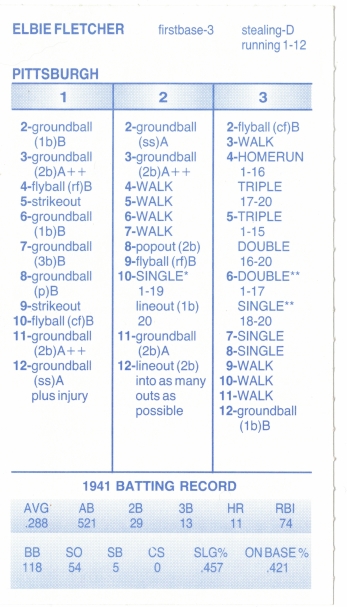
My initial, solely from memory, take on this first round game was that I thought the Twins of the 80’s were pretty good and the Pirates of the 40’s were pretty bad.  Turns out I was incorrect on both counts, with the 1941 Pirates (who went 81-73...and 2 ties!) having a solid all-around lineup keyed by Arky Vaughn, Elbie Fletcher, and the third Dimaggio brother, Vince, a CF-1 with 21 HR.   On the other hand, the 1982 Twins lost 102 games and, although Kent Hrbek and Tom Brunansky provided some pop, their pitching staff was a minefield and swing starter Jack O’Connor seemed to be their best option against Pittsburgh’s Rip Sewell.   Two walks and a single off O’Connor and the Pirates quickly jump to a 1-0 lead in the top of the 1st, and a solo shot from Dimaggio pushes the lead to 2-0 in the 3rd.  A Fletcher triple in the 5th leads to two more runs, but the Twins finally get on the board in the bottom of the inning with a Tim Laudner solo shot--only the second Minnesota hit of the game.   When O’Connor loads up the bases in the top of the 6th, the Twins hand the ball to Ron Davis, and Elbie Fletcher immediately nails a grand slam off Davis’s card that sends the few fans in the Metrodome streaming for the exits.   The Twins scratch out another run on a Gary Ward fielders’ choice but that’s all, folks, for the Twins, as the Pirates move on to the semis with the easy 8-2 victory.

The 78-75 1911 Red Sox were led by Tris Speaker and Harry Hooper, and they sent 23-game winner Joe Wood to the mound to face a team from nearly a century later:  the 89-win 2007 Padres, who countered with 19-game winner Jake Peavy and a lineup where 2/3rds of the hitters out-homered Speaker, the top Boston slugger.  But it was the Red Sox who displayed some punch when cleanup hitter Duffy Lewis smacked a 2-run homer in the bottom of the 1st to give Boston the quick lead, and a Les Nunamaker sac fly made it 3-0 in the 2nd.  RBI singles from Milton Bradley and Adrian Gonzalez narrow the lead to 3-2 in the 3rd, and in the 5th Mike Cameron doubles in Marcus Giles and he later scores on a Gonzalez sac fly, and the Padres take a 4-3 lead.  The Red Sox roar back in the bottom of the inning, loading the bases with no outs against Peavy, but only convert one run on a Lewis sac fly and the game is tied at 4 apiece after five.  When Boston gets two squib singles against Peavy in the 6th, the Padres eye their deep bullpen but decide to stick with their staff ace, and the next batter Larry Garder nails the only complete hit on Peavy’s card to put the Red Sox ahead.  Not to be outdone, the Padres load the bases against Wood with no out in the 7th, and Gonzalez rips a single that scores Brian Giles but Cameron (1-16) is nailed at the plate.  Khalil Greene adds a sac fly, and the Padres retake the lead, 6-5, with neither team showing any signs of giving up.  Sure enough, Boston ties the game in the 8th when Peavy commits a 2-base error and Gardner singles him home, but Milton Bradley responds with a solo shot in the top of the 9th that puts the Padres up 7-6.  So, it’s up to Peavy, and he fans Harry Hooper but Speaker doubles into the LF corner, and the Padres summon Heath Bell to try to close things out--but the first batter he faces, Duffy Lewis, singles for his 4th RBI of the game and it’s tied once again.  Bell tries to recover his form, but the next two batters both single, with Steve Yerkes’s hit scoring Lewis for the walk-off 8-7 win.  Bell earns the loss by failing to retire a single batter, with Wood completing a sloppy win in which he allows 12 hits.

The survivors

It was 17-game winner Bob Purkey for the 1960 Reds against 15-game loser Billy Pierce for the 1949 White Sox in a semifinal matchup of first round upset victors.  And it was the White Sox looking to continue the trend of success for the underdogs, as they strike for 5 runs in the 1st courtesy of some sloppy Reds fielding and a 3-run HR by Chuck Kress off Purkey’s card.  The Reds get on the board in the 3rd when a Roy McMillan single is followed by 3 straight walks from Pierce, but the Sox get the run back when Kress again rolls Purkey’s HR split, misses it for the double, but scores on a Metkovich single that makes it 6-1.  Two straight hits for the Sox to lead off the 5th and the Reds aren’t going to let Purkey pitch to Kress; Jim Brosnan comes in and induces a DP ball to 3rd that Kasko boots, and after the dust settles it’s now 8-1 Sox.  The Reds come back with 2 runs in the 7th with a Pinson RBI double, but Don Wheeler drives in a run in the 8th to provide the Sox with additional insurance and the 9-3 lead.  The Reds get a couple of runners on in the 9th, but Pierce retires Wally Post to end the threat and the game, and the 91-loss White Sox earn an improbable berth in the regional final.

Lanning owns Boston
As the only ELO favorite to have won a game thus far in the regional, the 1941 Pirates were not taking the 1911 Red Sox lightly given Boston’s tenacity in coming from behind multiple times in their first round win.  The Bucs start off hot with a solo HR from their second batter, Arky Vaughn, and they were on their way to score more when Elbie Fletcher was cut down at the plate to record the final out of the 1st inning.  The Red Sox promptly load the bases in the bottom of the 1st, but Pirates starter Johnny Lanning artfully gets out of the jam unscathed.  A Bob Elliott sac fly in the 2nd makes it 2-0 Pirates, but after that Boston starter Larry Pape settles down, getting out of a bases loaded jam himself in the 7th to keep the score within reach.  A Stu Martin sac fly in the 8th does provide the Pirates with an insurance run, and the Red Sox never can solve Lanning as he completes the 5-hit shutout to send the Pirates to the regional finals with the 3-0 win.


The 1949 White Sox got to the regional final by winning every game as an underdog, while the 1941 Pirates did so by winning every game as a favorite, so something would have to give in this game that matched Pittsburgh’s Max Butcher against Chicago’s Bill Wight.   The Pirates began the game in the bottom of the 1st with a single, a triple, and an Elbie Fletcher HR and it was 3-0 before Wight recorded an out.  Wight then walks the bases full in the 3rd and the Pirates punish him for it, pushing across five more runs to make it 8-0 after three innings and the rout is on.  Two more walks by Wight in the 4th and the Sox finally throw in the towel on Wight and try Max Surkont and his 4.78 ERA, and although he immediately issues a walk to load the bases, the Sox turn a DP to get out of the inning without further damage.  The Sox finally push across a run in the 8th on a Bud Souchock triple, but Pirate 3b Lee Handley homers and that’s more than Butcher needs as he closes out the 10-1 blowout with a 6-hitter as the Pirates claim only their third regional title, with 1941 joining 1956 and 1960 as regional winners.


Interesting card of Regional #102: 
With two homers and 7 RBI in the three games of the regional, Elbie Fletcher was the offensive catalyst for the regional-winning Pirates, but he is hardly a household name in baseball lore after a career as a solid player on losing teams, so I thought he was deserving of this feature.  A “Moneyball” player before such a thing was contemplated, he led the NL in OBP three years in a row, including the 1941 season represented here, and he coupled this with a nice collection of extra base hits that made him a threat to hit for the cycle in every game.    Fletcher’s season did get him votes for NL MVP in 1941, finishing in 14th place in that vote, but his performance in this tournament earned him the distinction as MVP of Regional #102.


Friday, July 2, 2021

REGIONAL #101:   This group featured the pennant-winning 2008 Phillies as well a pair of teams from the Reds and the A’s, with the 1938 version of the Reds one year away from winning the NL twice in a row.  With those Reds and Phillies matched up in the first round, my hunch was that the winner of that game would take the regional, with the Phillies being my pick.  The ELO ranks also tapped the Phillies as the favorite, with the 2010 Rockies ranked as the best of a mediocre group of teams in the bottom half of the bracket.

First round action

In perhaps the best matchup of the 1st round of the regional, the 92-win World Series champion 2008 Phillies faced off against the 82-68 1938 Reds, who sent 21-game winner Paul Derringer to the mound against Cole Hamels.  The Phils moved out to a 2-0 lead in the 3rd on a Pat Burrell 2-run HR, and they add another run from a Shane Victorino RBI single in the 5th.  Jayson Werth’s solo shot in the 6th makes it 4-0, and although the Reds are getting plenty of baserunners on against Hamels, he seemed to pitch best from the stretch as he keeps the Reds scoreless until the 8th, when a 2-run double by Harry Craft makes it 4-2 and the Phils summon Brad Lidge to close things out.   Lidge is indeed “lights out”, striking out 3 of the 4 batters he faces, and the Phils move on to the semis with a 4-2 win despite getting outhit 10 to 6 by the Reds.

The 68-win 1953 Reds and the 53-win, last place 1934 White Sox took similar paths to mediocrity, with both teams boasting a couple of big hitters (Ted Kluszewski and Gus Bell for the Reds, Al Simmons, Luke Appling and Zeke Bonura for the Sox) but questionable pitching staffs.  The Reds find Sox starter George Earnshaw’s hits quickly, with Grady Hatton smacking a 2-run homer off Earnshaw’s card in the top of the 1st to give Cincy a quick lead.  Earnshaw does settle down, but Andy Seminick nails him for a 3-run HR in the 6th, and Earnshaw is injured on the following at bat and leaves the game with a 5-0 deficit.  Hatton drives in another run with an RBI single in the 8th, and obscure Reds starter Fred Baczewski has a shutout going until the bottom of the 9th, when an error by ss-1 Roy McMillan allows an unearned run as a minor blemish on the Reds’ 6-1 win.

Given the season they came from, the makeup of the 86-win 1968 Indians was not surprising--an outstanding pitching staff coupled with anemic offense.  With 21-game winner Luis Tiant and his 1.60 ERA on the mound, the Indians looked like solid favorites over a 96-loss last place 1960 A’s team with Ray Herbert starting.  This one had all the markers of a low-scoring game, and it was a scoreless tie until the 6th, when Jose Cardenal hit his 2nd double of the game off Herbert’s card and Lee Maye singled to score Cardenal and give the Indians the 1-0 lead.  Tony Horton then misses a HR 1-13 split with a 14, and Maye is cut down at the plate trying to score on the resulting double to end the rally.  Tiant keeps the A’s under wraps until the bottom of the 9th, when pinch hitter Hank Bauer doubles to lead off the inning, and then Tony Horton drops a Bill Tuttle grounder to put the tying run on 3rd with nobody out.   Indians LF Lou Johnson then misplays a Dick Williams single and the game is tied, with the winning run on 3rd in the form of Tuttle.  Tiant insists on remaining in the game, and escapes the jam to send the game to extra innings tied 1-1.   The Indians score in the top of the 10th when Maye doubles home Max Alvis, and Tiant retires the side in order in the 10th to preserve the 2-1 win, completing his 10 innings having allowed only 5 hits.

The final first-round game of the regional matched two squads with similar .500+ records. As the second team from the Year of the Pitcher to play in this regional, the 82-80 1968 A’s lived up to the billing offensively, with little else aside from Reggie Jackson to stir the drink, but Blue Moon Odom (16-10, 2.45) was a very solid #1 starter. Their opponents, the 83-79 2010 Rockies, boasted a mile high offense with numerous weapons, and 19 game winner Ubaldo Jimenez looked plenty capable of handling the A’s hitters.   The Rockies took a 3-0 lead in the 4th on back to back homers by Miguel Olivo and Ian Stewart, and Jimenez is cruising until he’s hurt making the final out of the 6th inning and has to leave the game, forcing the Rockies to turn to some rather frightening bullpen options.  The A’s promptly score in the 7th on a fielders choice from Mike Hershberger to narrow the lead to 3-1, but the Rockies turn to closer Huston Street who retires the A’s in order in the 9th, and the Rockies move on with the 3-1 win.

The survivors

Having survived a late challenge in the first round, the 2008 Phillies tapped veteran Jamie Moyer to start against Joe Nuxhall and the 1953 Reds, who had won comfortably despite little production from the bigger bats in their lineup.   One of those bats, Big Ted Kluszewski, remedies that state of affairs with a 2-run homer in the bottom of the first, but Reds RF Willard Marshall ends the inning coming up lame on a groundout and needs to leave the game.  That lead proves to be short-lived when Ryan Howard smacks a 3-run homer in the top of the 2nd and Pedro Feliz adds a solo shot that makes it 4-2 Philly.  The Phils add another 4 runs in the 3rd, including Howard’s second 3-run blast of the game, and it looks like the rout is on as the Reds have no good options in the bullpen to replace Nuxhall.  Unfortunately for the Phils, disaster strikes in the 4th when their all-star 2b Chase Utley is injured, like for the tournament, leaving them with a hole they can do little to fill.   Greg Dobbs doubles in a run in the 5th to make it 9-2, and the Phils score another in the 6th when Utley’s replacement, Eric Bruntlett, hits into a DP with a runner on 3rd.  The Reds nick Moyer for a run in the bottom of the 6th on a Greengrass RBI single, but Dobbs gets that back and more with a 3-run shot in the 7th and it’s now 13-3.  The Reds continue to fight, with a Grady Hatton homer making it 13-5, but with the huge lead Moyer coasts through the final innings and the Phils waltz into the regional finals--minus one of their most valuable players.

The semifinal between the 1968 Indians and the 2010 Rockies matched the best rotation in the regional--with Sam McDowell and his 1.81 ERA as the number #2 starter-- with an offensive-minded squad that struggles to field starting pitching with an ERA under 5.00.   The teams trade goose eggs until the top of the 6th, when Lou Johnson nails a split double off Jhoulys Chacin’s card and the Indians take a 2-0 lead.  That seems to wake up the Rockies offense, and a Todd Helton RBI single with a Dexter Fowler triple ties the game in the bottom of the inning.  The Indians defense fails McDowell in the bottom of the 8th as a Tony Horton error and a single past SS Larry Brown leads to Fowler’s second RBI of the game, and the Indians enter the 9th down 3-2.  However, in the top of the 9th Max Alvis singles off Chacin’s card, Brown beats out a sacrifice bunt, and the Rockies turn to Huston Street for the second consecutive game to try to secure the win in the 9th.  Street strikes out the side, and the Rockies move to the finals with a tight 3-2 win in which they only mustered 6 hits against Sudden Sam.


Down for the count
The only two 21st century teams in this regional were to meet in the finals, although this might have been expected because every game in the regional to this point had turned out consistent with the ELO rankings  As such, the favored 2008 Phillies had to feel good about their chances against the 2010 Rockies despite losing Chase Utley for another 6 games, but with neither starting pitcher--PHN’s Brett Myers and COL’s Jorge de la Rosa--inspiring much confidence some offensive fireworks were anticipated.  Three walks by de la Rosa and a Clint Barmes error give the Phils a 1-0 lead in the top of the 1st, but Jayson Werth returns the favor with a 2-base error in the bottom of the 1st and Brett Myers allows a 2-run single to Seth Smith to provide the Rockies with a 2-1 lead.  Werth then atones in the top of the 2nd with a 3-run homer to give the Phils a 4-2 advantage, but after recording 2 outs in the bottom of the inning Myers comes up with a sore arm and the Phils bullpen will need some long relief to hold their lead.  The Phillies add to the margin when Jimmy Rollins leads off the 4th with a triple and Shane Victorino singles him home, but the Rockies narrow it to 5-4 in the bottom of the inning with an Ian Stewart 2-run blast.  An RBI double by Rollins in the 5th finally chases de la Rosa, with Rafael Betancourt called upon to try to keep the game within reach, but Betancourt immediately turns a Victorino grounder into a 2-base error and two more runs, and it’s 8-4 Philadelphia after 5.  Meanwhile, the Phillies bullpen is holding its own, and they turn to Lidge for the 9th inning, but a walk, a single, and a Dexter Fowler triple and it’s suddenly 8-6 with the tying run at the plate in the form of Todd Helton.  But Lidge fans Helton to secure the win and the regional title for the Phillies to go along with their real-life World Series championship.  Worthy of note--the ELO favorite won every game in this regional.


Interesting card of Regional #101: 
 I really struggled trying to decide on a selection for this regional, as the two finalists were 21st century teams and I favor older layouts of Strat cards.  However, I eventually went with Rockies outfielder Carlos Gonzalez; he pretty much had it all in 2010, average, power, speed, and defense.  Unfortunately, he didn’t really do much for the Rockies in the regional, with only one hit in the three games, and not a single RBI.  What strikes me as interesting about Gonzalez was that in setting the lineup for the Rockies, I noticed that Baseball Reference listed him as a bench player--one who led the NL in hitting and came in 3rd in the MVP voting.  I found it remarkable that although Gonzalez played all three outfield positions (and obviously pretty well, given his three “1” defensive ratings), the Rockies played somebody more than Gonzalez at every OF position--even though Gonzalez ended up with far more plate appearances than any other outfielder.  I started Carlos in LF all three games, but given his lack of productivity in this regional, maybe Baseball Reference was on to something.